Butterflies! I love them. I am enthralled by their process of metamorphosis. Over the years, I have raised dozens of them indoors and watched them grow and change from tiny caterpillars to delicate chrysalises to beautiful butterflies. Often I share this experience with my students, who are as fascinated as I am, learning along with them.
I am able to identify most of the butterflies I spot thanks to the book Butterflies of Egypt: Atlas, Red Data listing & Conservation by Francis Gilbert and Samy Zalat. You can download the book for free here. Many thanks to the authors for sharing this amazing resource!
In the photo collection above, you can see:
Large Salmon Arab (Colotis fausta) Grass Jewel (Chilades trochylus) Small White (Pieris rapae) African Babul Blue (Azanus jesous) Saharan Swallowtail (Papilio saharae) Dark Grass Blue (Zizeeria karsandra) Desert White (Pontia glauconome) African Caper White (Belenois aurota) African Monarch (Danaus chrysippus) Pomegranate Playboy (Deudorix livia) Painted Lady (Vanessa cardui) Long-tailed Blue (Lampides boeticus) Scarce Green-striped White (Euchloe falloui) Mediterranean Tiger Blue (Tarucus rosaceus)
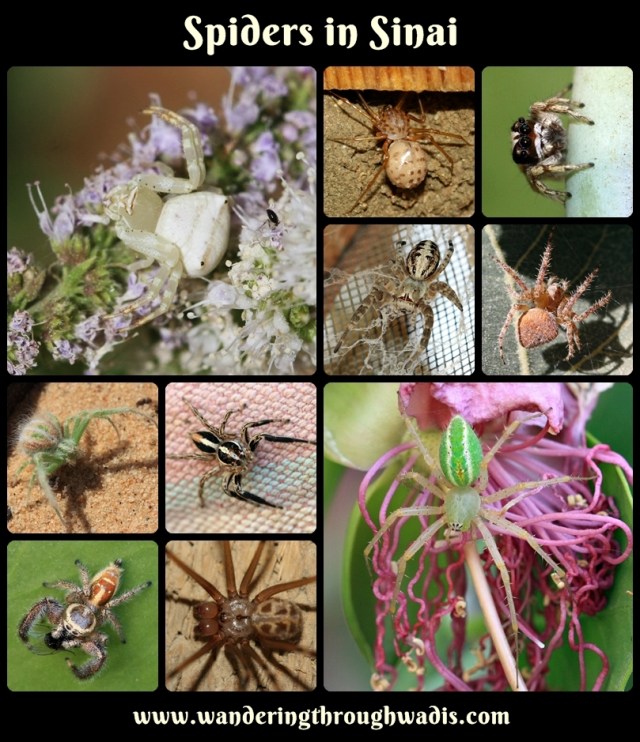
It wasn’t until I turned my camera lens from the desert blooms to the creepy crawlies that I got over my fear of spiders. Mostly. Big, hairy ones still freak me out. But the little ones I find around the local wadis and my own desert garden have grown on me and I think they are quite stunning! Luckily, none of these commonly seen spiders are venomous, but there are dangerous spiders in Sinai, like the rare White Widow Spider. Camel Spiders are not spiders nor scorpions, but rather in their own order of Arachnids.
“Sinai is one of the very few places in the world (and it may be unique) where no social bees of any kind occur naturally, only solitary bees…Recently hives of domesticated social honeybees have been brought in from Egypt, and scientists are worried about their impact on the wild bees, and hence on the efficiency with which native plants are pollinated. ” ~ Gardens of a Sacred Landscape: Bedouin Heritage and Natural History in the High Mountains of Sinai by Samy Zalat and Francis Gilbert
Pictured here:
Top Right: Carpenter Bee (Xylocopa sp), which you can learn more about in this post.
Bottom Right: Leafcutter Bee (Coelioxys sp), which you can learn more about in this post.
There have been several reports in the past year of hives of social bees in Dahab and Nuweiba. After reading the book quoted above, I have been fascinated about their possible impact on the native solitary bees and plants, so I did a bit of research and found two very interesting articles:
Sinai Wild Bees Under Threat (Scientists warn against the negative impact of honeybees’ introduction on wild bees and native plants in South Sinai.)
Human interference in the natural order of our ecosystems is not always a good thing. I’ll be thinking twice now about buying honey from St. Katherine’s…
Flies can be pesky for sure, but when you take a closer look, many of them are quite beautiful! Flies are in the order Diptera, which includes not only those pesky house flies but horse-flies, crane flies, fruit flies, hoverflies, midges, and mosquitoes.
In this sampling of flies in Sinai, you see:
Top Left: Band-eyed Hoverfly (Eristalinus taeniops)
Bottom Left: Common Green Bottle Fly (Lucilia sericata)
Top Right: Hoverfly (Eupeodes corollae)
The other two images are unidentified fruit flies (Drosophilidae family).
Beetles, forming the largest order of insects with nearly 400,000 identified species, account for nearly 40% of all insects. So I guess it’s no surprise that my collection of beetle images is one of my largest!
Here’s what you can see in this sampling:
Blister Beetle
Carpet Beetle
Darkling Beetle
Red Palm Weevil
Seven-spotted Ladybug
Hairy Rose Beetle
Jewel Beetle
and a few unidentified beetles (the blue/green ones…can anyone help with an ID?)
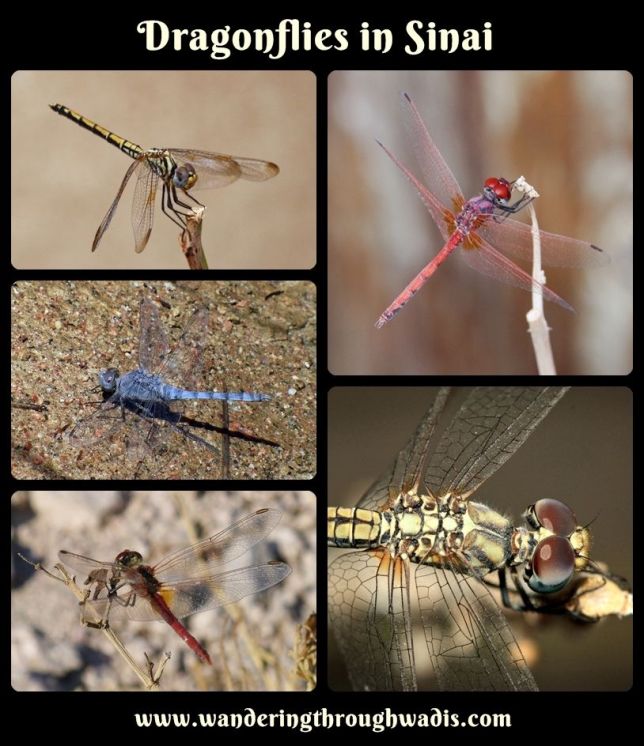
A couple of months ago, my external hard drive malfunctioned and I lost thousands of my photos – mostly my pics of Sinai wildlife. Fortunately, my talented husband was able to recover a good chunk of the images. Recently, instead of wandering through wadis shooting new photos, I’ve been sorting and renaming all the recovered images. It’s a bit tedious and overwhelming, so I took breaks to put together different collections, like this one – Dragonflies in Sinai. I’ll be sharing some more of these over the next few weeks so stay tuned. 🙂
Top Left and Bottom Right: Violet Dropwing (Trithemis annulata)
Middle Left: Desert Skimmer (Orthetrum ransonneti)
Bottom Left: Slim Scarlet-Darter (Crocothemis sanguinolenta)
Top Right: Unknown
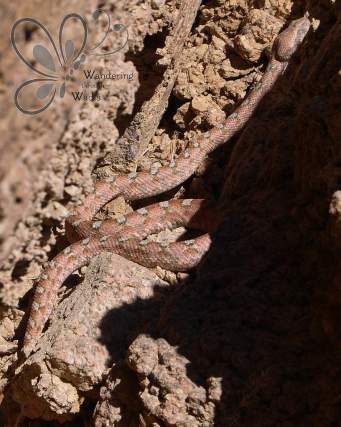
Although I’m super excited to share this venomous viper with you today, I’m also super thankful that I don’t come across them more often on my wanderings. Why? Because “species in the genus Echis are responsible for the greatest proportion of all snake bite fatalities in humans.” (ARKive) Eek!
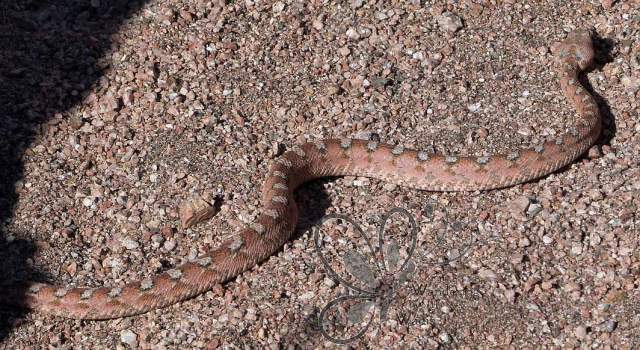
This Burton’s Carpet Viper (Echis coloratus) was spotted in a wadi in Dahab, moving away from us – or we wouldn’t have been so excited to come across it! But it took its time crossing the narrow path in front of us and then slithering its way up the sunny rocks, giving us plenty of time to observe its beauty.
These vipers have short, stocky bodies and wide heads and can grow to lengths of 75 cm. Their backs are covered with a pattern of pinkish-grayish blotches that have a darker outline. They also have dark gray bands that stretch from the eyes to the corners of their mouths. Their coloration gives them excellent camouflage against the rocks.
Called hayiah or um jenah by the Jebaliya Bedouin, these vipers are fairly common in South Sinai and can be found at elevations up to 2,000 m. They typically live in rocky mountainous regions, on steep slopes, ledges, cliffs, and in rocky wadis. They are nocturnal and crepuscular, active during twilight. But we spotted this one on the move at around 9 in the morning.
Another name for these vipers is the Palestine Saw-Scaled Viper. This name comes from their defensive strategy of rubbing their coils together to produce a strong hissing or sawing sound when approached, especially to deter humans as they don’t want to waste their precious venom on us. Other names include the Arabian Saw-Scaled Viper, Mid-East Saw-Scaled Viper, and the Painted Carpet Viper.
Burton’s Carpet Vipers are unusual among vipers as they lay eggs, whereas their relatives give birth to live young. The vipers feed on small mammals, birds, lizards, and large invertebrates. They have long, hollow fangs that they can reportedly fold back against the roof of their mouths when not in use.
Seeing as this viper and its relatives are considered to be among the world’s most dangerous snakes, I will be sure to pay better attention when I set up camp in the desert!
References:
Aly, D. & Khalil, R. (2011). Wildlife in South Sinai. Cairo.Funded by the E.U. in cooperation with G.O.S.S.
Baha El-Din, Sherif. (2006). A Guide to the Reptiles and Amphibians of Egypt. Cairo: The American University in Cairo Press.
Palestine saw-scaled viper (Echis coloratus) on ARKive.org
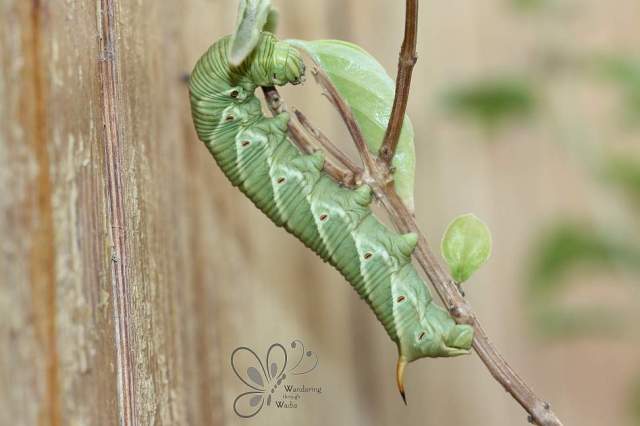
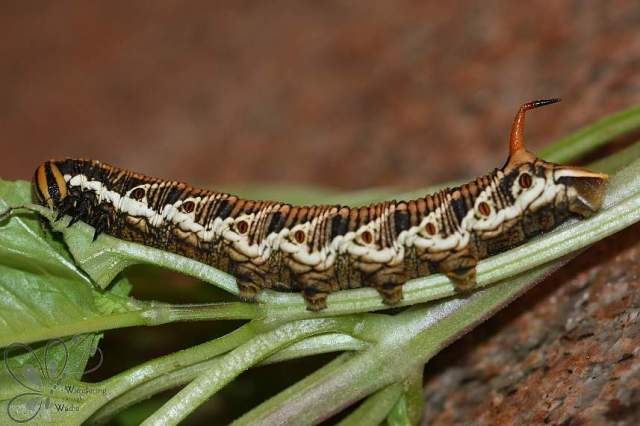
It’s been almost a year exactly since I shared a photograph of an unknown caterpillar that was devouring the basil plant in my garden. A few months ago, my students and I were able to successfully raise one of those critters indoors and finally identify it as a Convolvulus Hawkmoth (Agrius convolvuli)!
Again, we had found the caterpillar munching my basil plant, but my husband and I have also found eggs on a sweet potato plant at his farm.
The eggs are smooth, greenish spheres and are laid on the underside of leaves. The larvae will eat a range of plants, including but not limited to daisy, taro, morning glory, sunflower, purslane, and some legumes. And as we’ve learned – basil and sweet potato!
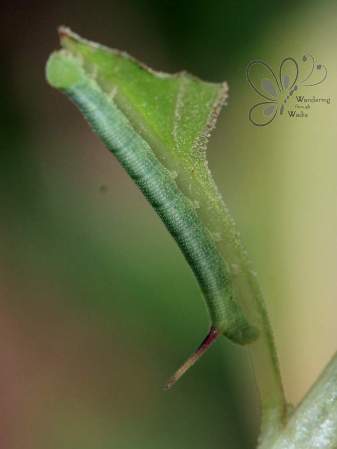
The young caterpillars are green with a straight horn on their tail ends, but the larvae will go through five instar phases, molting its skin at each stage.
Later instars develop pale diagonal stripes and their horns curve backward. Even later instars may become dark brown. The caterpillars are quite large, growing up to 8 cm in length.
Our caterpillar buried a few centimeters under gravel and leaf litter to form its pupa, which was glossy and reddish brown. The moths spend between 5 and 26 days in this stage.
Adults Convolvulus Hawkmoths are grey with light and dark patterns. The abdomen has pink patches on the side of each segment.
I have never seen these moths flying, but like other hawkmoths, they are able to hover in flight.
I am thrilled that we were able to raise this – my first! – moth and share our discoveries with you! Have you ever raised butterflies or moths at home? It truly is a fascinating experience.