Large Carpenter Bees

If you follow the blog on Facebook, you might recall that a couple of weeks ago I announced the arrival of the bee-eaters, my all-time favorite birds who migrate through Egypt and Sinai in the spring and autumn. After that post, someone asked me what exactly the bee-eaters ate here in Sinai and was surprised to learn about the variety of bees around. I promised I would dedicate my next blog post to one of our local buzzers. So today I am pleased to introduce you to the Large Carpenter Bees (Xylocopa sp.).

Carpenter Bee (4)

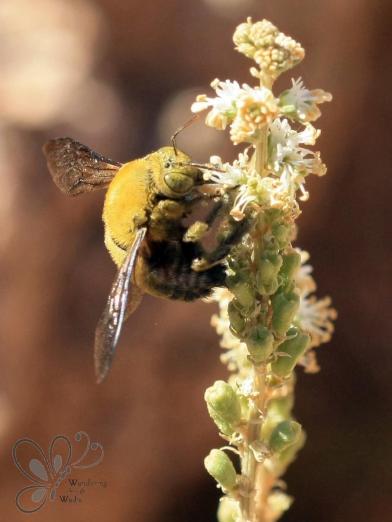
I have a Parkinsonia tree in my garden and it is currently bursting with blooms, which these large buzzers just love! They are usually difficult to catch an image of, but the one pictured above sat on my front door absolutely still for quite some time. Not sure why, but I was happy for the opportunity to get some photos.

According to the authors of Gardens of a Sacred Landscape, “Sinai is one of the very few places in the world (and it may be unique) where no social bees of any kind occur naturally, only solitary bees.” Solitary bees, like the Carpenter Bees, do not build hives and do not produce honey, but they are important pollinators.

Carpenter Bee (1)

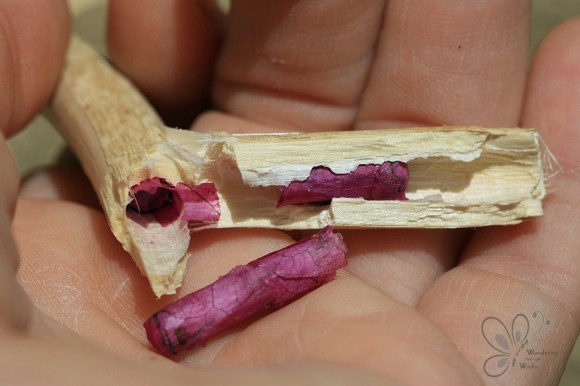
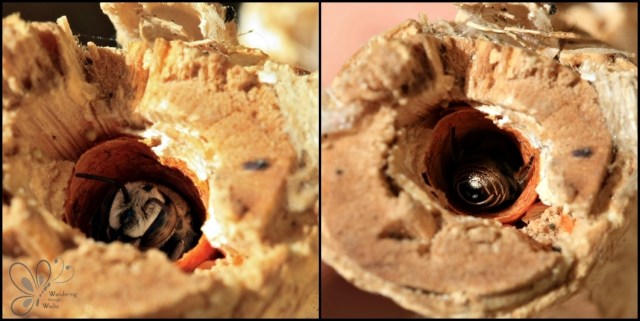
Carpenter Bees are named for their nesting behavior; they burrow into dead wood or other hard plant material, like the old bamboo chair in my garden.

IMG_7167

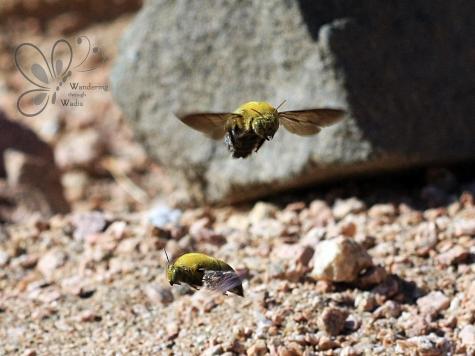
Large Carpenter Bees are – surprise, surprise – large. They are usually 2 cm or longer, whereas Small Carpenter Bees (Ceratina sp.) are often less than .80 cm. Although there is variation between species – and I can find no definitive list on the specific ones found in Sinai – most Carpenter Bees are primarily black, some with white or yellow fuzz. The ones spotted in my garden are quite yellow, but others I’ve seen in the wadis have paler fuzz.

Bee_Wadi Kostya (1)

Their wings produce a loud buzzing sound when they fly and these bees are often confused with bumblebees. To tell the difference, look at the abdomen. Carpenter Bees always have a shiny abdomen while a bumblebee’s will be covered in hair.

Wadi Paradise_Feb14 (21)

Carpenter Bees are indeed part of a bee-eater’s diet. Shrikes will also feed on these large bees. Both birds have ways to deal with the female bee’s stinger. (Males do not have stingers.) Luckily for us humans, the bees are quite docile and rarely sting unless they are directly provoked.

Wadi Paradise_Feb14 (57)

I’ll feature some of Sinai’s other buzzers over the next couple of weeks, as I continue with my attempt (in vain?) to catch some photos of the fabulous bee-eaters. I can hear them calling right now!

Ladybird Beetles

Desert Garden Ladybugs (2)

Ladybird Beetles, or Ladybugs as I grew up calling them in North America, are quite well-known beetles, but some people may be surprised to learn that you’ll find these colorful beetles in the deserts of Sinai.

Desert Garden Ladybugs (1)

Ladybirds are red, yellow, or orange colored beetles with small black spots on their wing covers. They have small dome-shaped bodies and six short legs. Contrary to popular belief, the number of spots do not indicate age but rather a specific species. Both of the beetles pictured above are Seven-spotted Ladybird Beetles (Coccinella septempunctata), one of the most common.

I have also seen Eleven-Spotted Ladybirds (Coccinella undecimpunctata), pictured below, on caper plants in the wadis around Dahab.

Ladybird Beetles (5)

Both the larvae and adults feed on aphids, small insects that suck the sap from plants. Ladybirds are therefore quite useful in helping to fight these pests in gardens, especially the ones in the mountains around St. Katherine’s, but also in my own desert garden. 🙂

Wadi GNai_Oct13 (12)

When threatened, adult ladybirds release a yellow substance from a joint on their leg that is distasteful to predators and convinces them to find their next meal somewhere else.

Ladybird Beetles (4)

The Bedouin in Sinai call Ladybird Beetles ‘uwaynat umm sulayman, or “the eyes of Solomon’s mother”.

In traditional folklore in some cultures, Ladybird Beetles are thought to bring good luck. Have ladybirds brought you any luck in the Sinai?

References:

Zalat, S., & Gilbert, F. (2008). Gardens of a Sacred Landscape: Bedouin Heritage and Natural History in the High Mountains of Sinai. Cairo: The American University in Cairo Press.
Seven-spot ladybird (Coccinella septempunctata) on ARKive.org

Bosc’s Fringe-toed Lizard

Bosc Lizard_Najaeen (1)

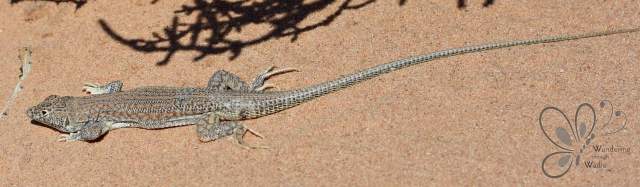
Fringe-toed Lizards are Egypt’s most prominent reptiles and this species, the Bosc’s Fringe-toed Lizard (Acanthodactylus boskianus), is the most common diurnal reptile in Sinai. Diurnal means “active during the day” and these guys start to venture out of their burrows at mid-morning, on the lookout for insects like flies, beetles, and grasshoppers, or perhaps some spiders, to munch on.
Bosc Lizard_Najaeen (3)

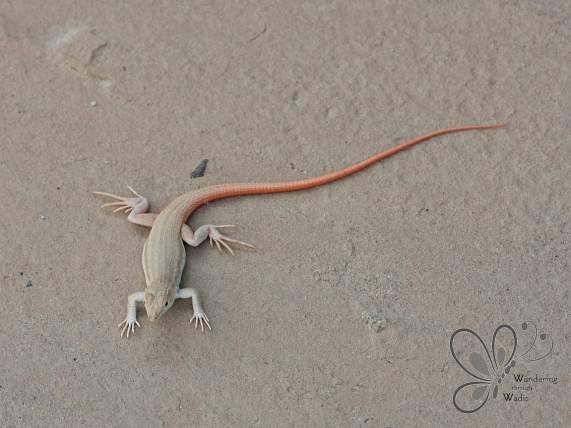
There is a lot of variation when it comes to the number of scales, size, shape of head, pattern, and color of Bosc’s Fringe-toed Lizards. They can range in color from dark or olive grey to reddish brown and their scales are keeled, or ridged. There are five dark-colored stripes on their backs, but these fade with age. Males are generally larger than females and juveniles often have blue tails. During breeding season, the tails of females turn red.

najeen 2014

These fringe-toed lizards inhabit deserts and semi-deserts. The lateral fringes on their toes are a special adaptation to help them move across loose sand. When wandering through wadis, you will often see these lizards scuttle ahead of you when they hear you coming, often darting beneath the nearest plant. If you look closely, you can also spot their tracks in the soft sand.

IMG_3691

Bosc Lizard_Najaeen (5)

While on safari two years ago, I was packing up my tent one morning and was surprised to turn around and see mating fringe-toed lizards! I took dozens of photos of them and they did not seem to mind my presence. According to ARKive, “During courtship the male approaches the female with a bent neck, and then runs in semi-circles, whilst probing the female’s body with its tongue.” Probing? Looked more like biting to me, but I’m no lizard!

El Fuqeyya (13)

El Fuqeyya (14)

If the female is receptive to these advances, she will lift her tail, allowing the male to make contact.

El Fuqeyya (32)

El Fuqeyya (29)

El Fuqeyya (31)

Looking quite satisfied there, isn’t he? (Yes, I’m projecting.)

References:

Baha El-Din, Sherif. (2006).  A Guide to the Reptiles and Amphibians of Egypt. Cairo: The American University in Cairo Press.

Bosc’s fringe-toed lizard (Acanthodactylus boskianus) on ARKive.org.


Hyena’s Fart ~ Desert Mushroom

Podaxis pistillaris

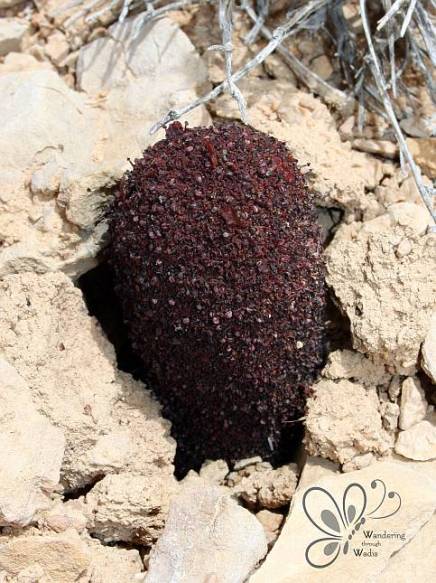
The Bedouin of Sinai call this desert mushroom (Podaxis pistillaris) “hyena’s fart” in Arabic because they seem to appear out of nowhere, just like the hyenas (used to) do. And they do indeed pop up suddenly! But their spores, which can live for many years without water, have been there all along, under the desert sands, waiting for rain.

It was the Spring of 2014, after a very wet winter, that we spotted scores of these mushrooms dotting the sandy desert plains. A relative of the puffballs, this mushroom, sometimes called a Black Powderpuff, can grow up to 15 – 20 cm high. It has a large white cap that protects the inner blackish tissue. This tissue contains the spores, and when the mushroom reaches maturity, the cap will split open and fall away, allowing the spores to be dispersed by the wind.

These mushrooms – a good source of protein, essential amino acids, carbs, lipids, and minerals – are roasted and eaten by the Bedouin of Sinai.

Other common names in English for this mushroom include Desert Shaggy Mane and False Shaggy Mane.

Sinai Rosefinch

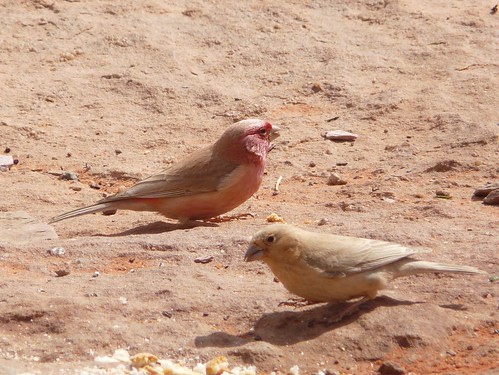
Although the national bird of Jordan, this finch is named after Egypt’s Sinai and lives in our dry, rocky desert areas. The male Sinai Rosefinch (Carpodacus synoicus) is easily identified by its crimson-pink plumage. Females and juveniles are a greyish brown color.

sinai-rosefinch-3

Sinai Rosefinch
Sinai Rosefinch by Alastair Rae, CC via Flickr

Sinai Rosefinches eat seeds and are often seen in groups. I spotted this group on top of Jebel Musa.
sinai-rosefinch-4

These finches grow to about 14 – 16 cm and breed in a small area of Sinai, southern Israel, and southern Jordan.

As I’ve mentioned before, photographing birds is not one of my talents, so check out this page with some beautiful images of Sinai Rosefinches and the video below.

Desert Thumb

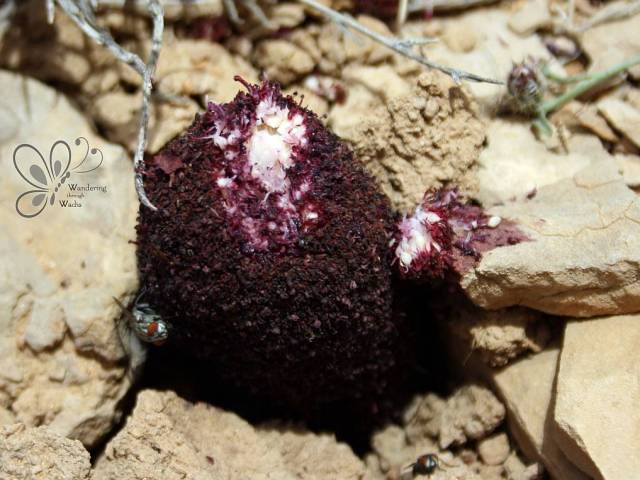
Desert Thumb (Cynomorium coccineum), aka Red Thumb or Tarthuth in Arabic, is not a common plant in Sinai. Growing in the spring only after a wet winter, this rare plant makes for a special spotting! I was intrigued when I came across these for the first time in 2014. I mistakenly thought they were mushrooms (so did the Maltese back in the 1600s so I’m not the only one!). With the help of my fellow nature lovers at Project Noah, I learned that these thumbs of the desert were actually plants.

cynomorium-coccineum-1

But they are no ordinary plants! They are parasitic; they have no chlorophyll and cannot photosynthesize. Instead, they live most of their lives underground as a rhizome, attached to the roots of another plant. In Sinai, Desert Thumbs most likely parasitize salt bushes (Atriplex spp.), but they are also known to live off the roots of Amaranthus and Tamarix species.

The stalk emerges in the spring, covered by clusters of tiny dark red to purplish flowers. The flowers are pollinated by flies that are attracted to their cabbage-like aroma. Once pollinated and mature, the spike turns black and produces small, black, nut-like fruit.

cynomorium-coccineum-3

Desert Thumbs are edible and are believed, throughout the region where they grow, to have an array of medicinal properties. In fact, Arab physicians during the Middle Ages referred to Desert Thumbs as “the treasure of drugs” because it was used to treat a range of problems from blood disorders to digestive and reproductive ailments. In Sinai, Bedouin have traditionally used these plants to cure colic.

cynomorium-coccineum-4

Bedouin in Saudi Arabia have been harvesting tarthuth for thousands of years as food for themselves and their camels. Tarthuth has been especially useful during long caravan treks through the desert as well as during times of famine. The spikes are cleaned and the outer skin is peeled off. The inner white flesh is reported to be like an apple – sweet, crisp, and juicy.

If I had known that three years ago, I definitely would have tasted this plant! We’ve had a relatively wet winter this year, so maybe I’ll get lucky and have another chance to sample a Desert Thumb this spring. I’ll be sure to let you know. 🙂

References and Further Reading:

Cynomorioum – Wikipedia

Cynomorium coccineum – Flora of Qatar

The Matelse Mushroom (Cynomorium coccineum): An Epic History of the Rise and Fall of the Treasure of Drugs

The Treasure of Tarthuth by Robert W. Lebling Jr. – Saudi Aramco World

Saharan Sand Snake

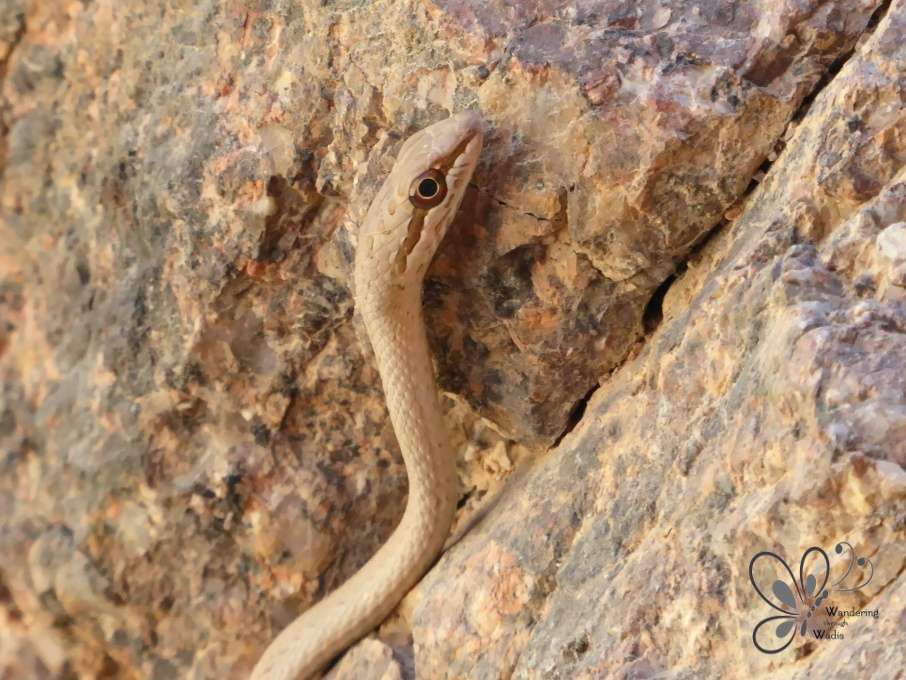
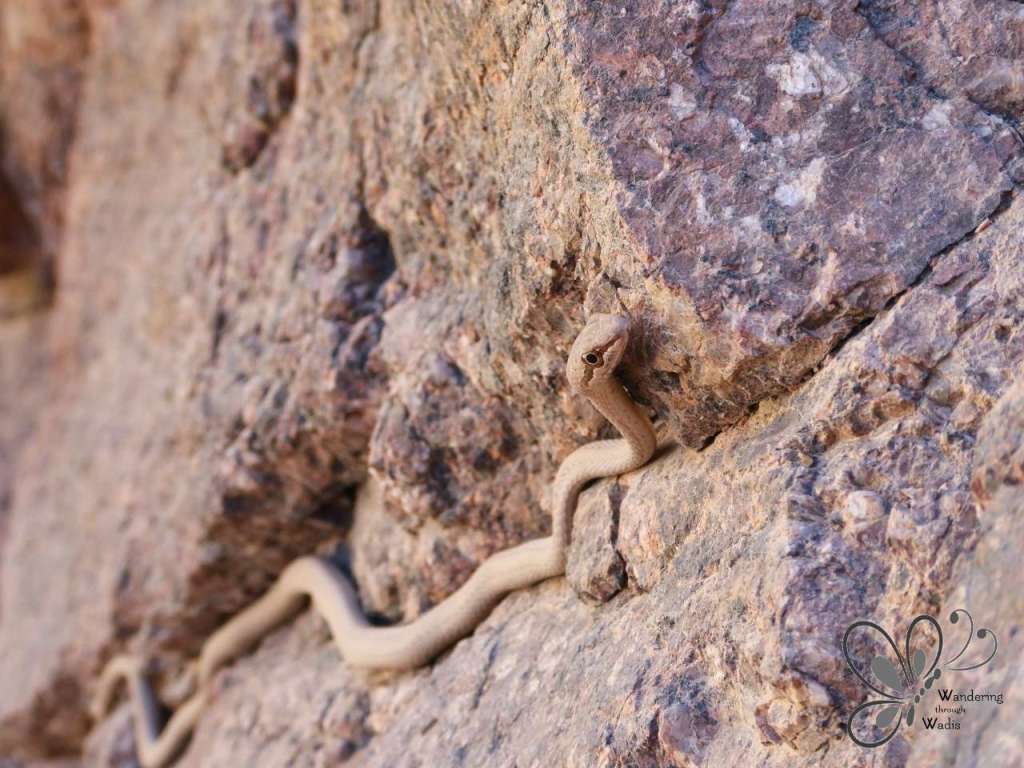
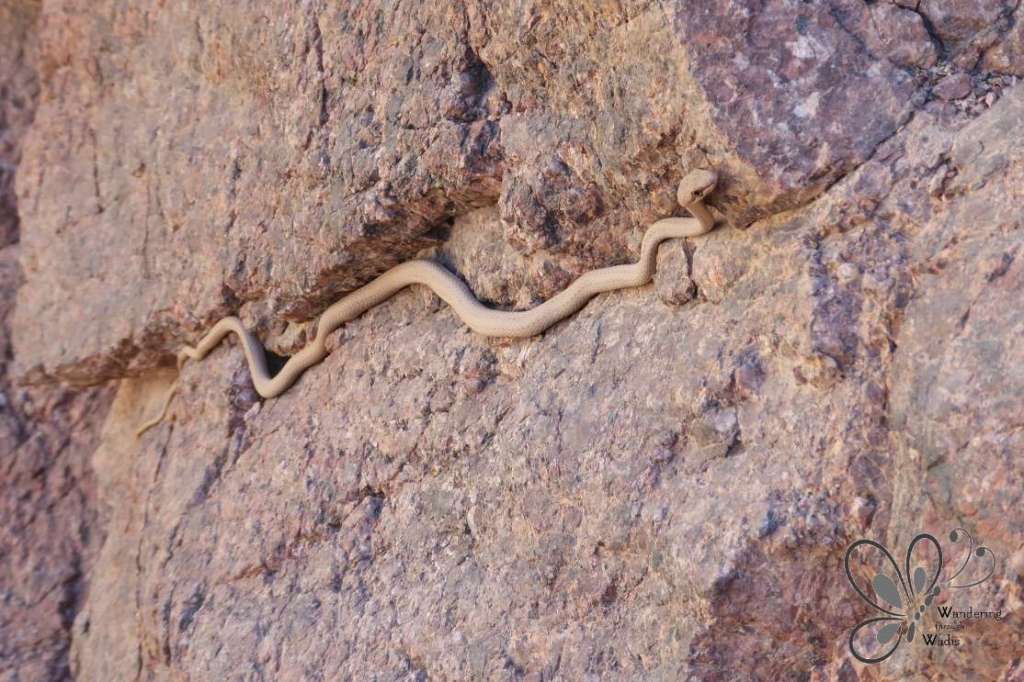
This past weekend we decided to wander along one of our usual routes, and I was treated to an unusual spotting – a sand snake! As we were walking, we passed a large dark boulder where I often spot agama lizards. I was just about to mention this to my friend when I looked down at the rock I was about to step on, suddenly realized that is what not a branch laying across it, and quickly had to swing around to avoid stomping on a snake. Eeek! I’m not completely comfortable with snakes apparently. But he was beautiful! A gorgeous golden-brown color with dark brown patterns. I wish I could share a picture of him, but I guess he was just as scared as me because he slithered away and hid beneath a rock.

We have spotted these sand snakes before, maybe three or four other times, in wadis near Dahab. The first time we saw one, in 2010, it was my husband who almost stepped on the snake. That time though, the snake stayed still long enough for us to take a few photos. And we (thought!) were able to identify it as a Schokari Sand Racer (Psammophis schokari), but years later (in 2023) with the help of expert Sherif Baha El Din, it has been IDed as a Saharan Sand Snake (Psammophis aegyptius).

These snakes are long and slender; they can grow to a length of about 1.5 meters. The patterns and colors of Schokari Sand Racers and Saharan Sand Snakes can vary a lot, ranging from a light sandy-gray with pale patterns to strong, dark contrasting colors.

[UPDATE] Since writing this post, I’ve encountered more Sand Snakes and, not being as startled, was able to get some new pics.

Schokari Sand Racers live in sandy and rocky deserts, prefer places with good vegetation, and are most common in coastal areas, whereas Saharan Sand Snakes are found in places with little or no vegetation. During times of bird migration, these snakes might be found on nearby trees and bushes. Here they wait to feed on the small songbirds that are flying through.

Schokari Sand Racers are found throughout the Sinai peninsula and are actually one of the most common snakes in Egypt. Saharan Sand Snakes are found only in South Sinai, not the north.

Notice the dark stripe that runs from the snout, past the eyes, to the back of the head.

And there’s a reason they’re called Sand Racers – they can reach speeds up to 16 kph when chasing prey! The snakes typically eat lizards, small birds, rodents, and other snakes. After grabbing their prey, they release a venom that immobilizes the animal before swallowing them head first. Despite being venomous, Schokari Sand Racers are generally not a threat to humans as their main defense is their speed. I’m grateful for that. 

Have you come across snakes during any of your wadi wanders? How did you – or  how would you – feel about such an encounter?

References:

Baha El-Din, Sherif. (2006).  A Guide to the Reptiles and Amphibians of Egypt. Cairo: The American University in Cairo Press.

Schokari sand racer (Psammophis schokari) on ARKive.org

Arghel

This is one of my favorite times of year to wander through the wadis of Sinai. For many reasons. Because of recent rains, the wadis are bursting with tiny green baby plants right now. I always enjoy stopping to discover what plants come up first after the rains, and what they look like when they’re so young. Fascinating! For me. 🙂 Another reason I love this time of year is that the arghel plants are in bloom – and they give off such a delightful fragrance!

img_3630

Some wadis, like Wadi Kid, are lined with arghel plants (Solenostemma arghel), called harjal in Arabic. If you are lucky enough to walk through one of these wadis in November, it will be a joy for your senses! Often you will smell the flowers before you turn a corner and see the plant.

near-wadi-gnai_22

Harjal is an evergreen shrub in the dogbane family. The plants grow up to 1 meter high and 10 meters in diameter. They live in gravelly, sandy, and rocky soils usually at the edge of wadi beds. Here’s a picture of a large harjal plant growing near Wadi Connection in Dahab:

wadi-connection_nov11-39

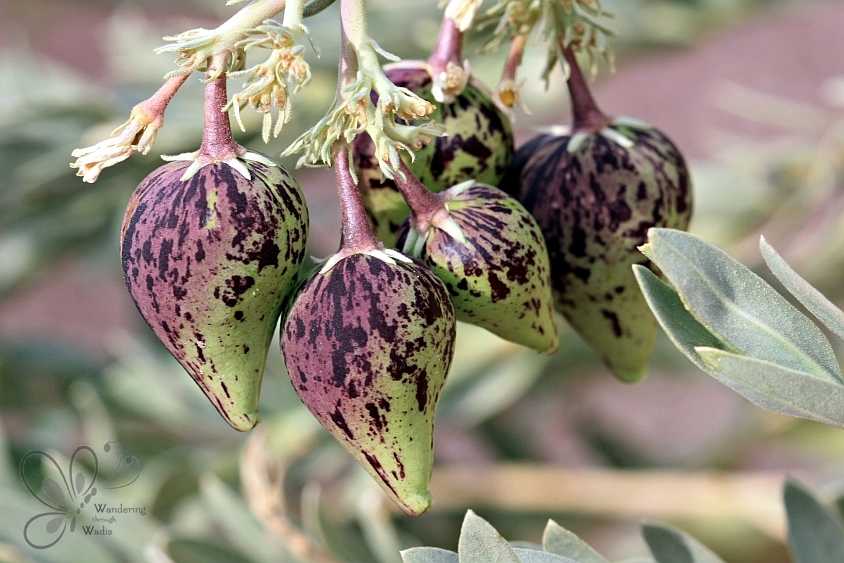
The leaves are greyish-green and their white flowers grow in bunches. The fruits are purplish-green, oval shaped, and can grow up to 5 cm in length.

wadi-connection_feb15-13

wadi-dahab-6

When they are ripe, they turn yellow and dry to a light brown. They split open, releasing dozens of tufted seeds that are blown by the wind.

wadi-connection_nov11-5

Bedouin in Sinai use this plant for medical reasons, as do many people throughout Egypt. Sadly, this plant is endangered due to over-collection for sale at herb shops dealing in medicinal herbs. Locally, the stem and leaves are used to treat a variety of ailments – infected sores and cuts, coughs and colic.

wadi-connection_nov11-40

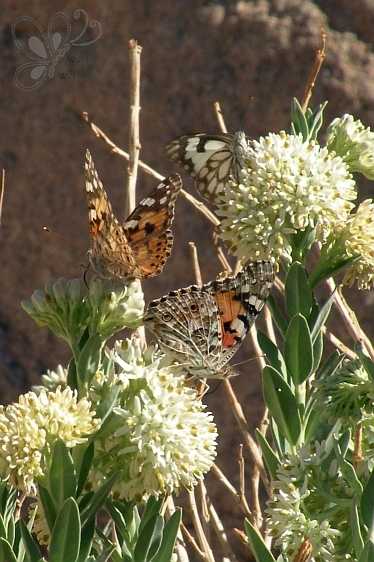
I’m not the only one attracted to these fragrant blooms! Butterflies, bees, and other pollinators are drawn to the flowers’ sweet nectar. In the picture below you can see two orange Painted Lady butterflies – the species I see most often on the harjal flowers – and a Brown-veined White butterfly.

wadi-gnai_nov12_21

wadi-gnai_nov12_22
Painted Lady Butterfly (Vanessa cardui)

Striped Hawkmoth

I promised – to those of you follow on Facebook – that my next post would be about this magnificent critter that I found on a basil plant in my garden –

img_6807

– as he was indeed the inspiration for getting back to work on this blog, and so today is all about…hawkmoths!

Unfortunately, I do not know – yet! – exactly who this bright green caterpillar is, but I do know that he (or she) is in the Sphingidae family of moths. Moths in this family are commonly called hawkmoths, sphinx moths, or hornworms. [Update: A year after I wrote this post, I was able to rear one of these caterpillars indoors; I believe it’s a Convolvulus Hawkmoth.]

There are over 1,450 species of Sphingidae moths. The larvae, or caterpillars, of hawkmoths are hairless and have a “horn” on the posterior end.

img_7226

Striped Hawkmoth (Hyles livornica)

And while I do not know which caterpillar was munching on my basil plant, I do know who was bending over backwards to eat the tips of desert lavender. That is a larva of the Striped Hawkmoth, Hyles livornica.

It was early spring 2013 and we had had a wet winter in Dahab. There had even been a hail storm in November. So the desert plants were flourishing in the wadis!

On one early morning wander, we came across an area lush with fresh green asphodel, lavender, and sorrel. And crawling across the sandy wadi were the most amazing caterpillars I had seen in Sinai! Dozens of them. Some of the largest were as long and thick as my index finger. They were happily munching on all the nearby herbs.

img_3144

img_7182

img_7194

Like all caterpillars, these Striped Hawkmoth larvae go through several stages of development, or instars, and their colors and patterns can change quite dramatically at each stage.

img_7285

Hawkmoth caterpillars will burrow into the soil or gravel or hide among the rocks to pupate and I have never seen that stage of development. But about a month after we saw the caterpillars, we discovered the adult Striped Hawkmoths. They were busy feeding on the dhafrah (Iphiona scabra) flowers.

wadi-kostya-3

Sphingidae moths are known for their rapid flight and ability to hover in midair while they feed. They use their long proboscis (mouth parts) to reach the nectar in the flowers. Male moths are typically smaller than females. Both are beige with white stripes. Their hindwings, not seen when the wings are at rest, are pink and edged with black and white.

img_2700

a Striped Hawkmoth, attracted to the light in the tent during a spring safari

img_2699

Dahab was blessed recently with several good rainstorms and young desert plants are already poking their heads through the sand. Let’s hope the plants start to thrive again and that we have beautiful green wadis to wander through this coming spring. The butterflies and moths would be happy with that, too!

References:

Striped hawkmoth ~ ARKive

Hyles livornica ~ Moth and Butterflies of Europe and North Africa

Hyles livornica ~ Wikipedia

Violet Dropwing Dragonfly

Being some of the largest insects you’ll come across as you wander through the wadis, dragonflies are often spotted. There is not a lot of easily-available information about dragonflies in Egypt, at least not in English. One report from 1980 claims that at least 52 species of dragonflies occur in Egypt. And, like for other flora and fauna, Sinai boasts the most exceptional species.

Dragonfly on Aloe (4)

Dropwing dragonflies, those in the Trithemis genus, are named for their habit of lowering their wings upon landing.

Dragonfly on Aloe (3)

This beauty is a female Violet Dropwing (Trithemis annulata). The males of the species appear purple or violet, hence the name, due to a powdery blue substance on top of a bright red body. The males also have red veins in their wings. The females have a yellow-brown body and no red in their wings. Both have a yellow- or amber-colored patch at the base of the hindwing.

Dragonfly on Aloe (6)

The female Violet Dropwings are the dragonflies that I spot most often, both in my desert garden and out in the wadis. As far as I know, I’ve never seen a male. Like all dragonflies, their life cycle begins when eggs are laid in water, meaning you are most likely to spot them near fresh, still water. Wadi G’Nai is often buzzing with these dragonflies!

Dragonfly - Garden (1)

Dragonflies have two sets of wings that they use to fly upwards and downwards, backwards and forwards, and side to side. They can also hover! And see those dark cells in the wings that are circled in the photo above? They are called pterostigmata. They help form a thicker, heavier section of the wing. This helps stop vibrations and allows the dragonflies to glide.  Amazing, right?

I have always loved dragonflies. For their size. For their colors. For their flight. And now I also love them because they visit my desert garden and strike poses on my aloe plants. And they sit still long enough for me to get my camera and take some pics. If you’ve got your own photos of dragonflies in Egypt, consider joining the Biodiversity in Egypt or the Wildlife of the Sinai Peninsula mission on Project Noah. Let’s see how many different species we can document!

References:

Notes on dragonflies in Egypt

Violet Dropwing ~ ARKive