Egyptian Pink Velvet Spider

Meet Fred. Fred is the name I give to all my pet spiders, regardless of their sex. I have had countless pet spiders over the years. They are the spiders living in my house, the ones I notice and try not to disturb. And many of my pet spiders have been Egyptian Pink Velvet Spiders, aka Desert Velvet Spiders (Stegodyphus dufouri).
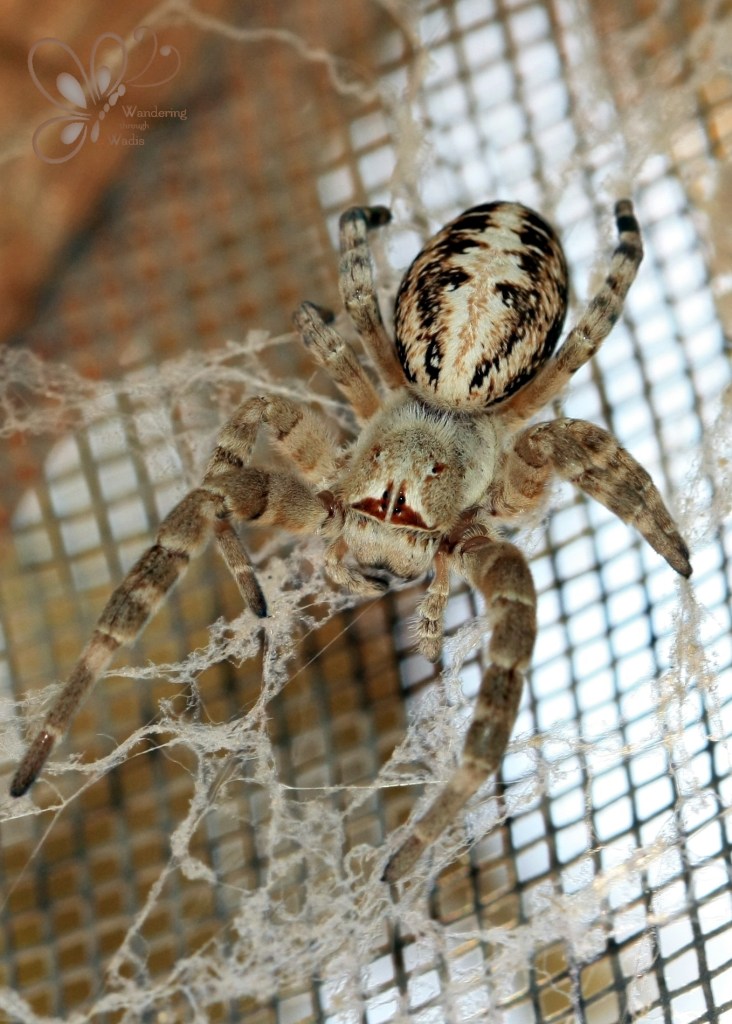
Velvet Spiders is the common name given to all spiders in the Eresidae family. There are nearly 100 different species in nine genera. Six of those species can be found in Egypt and three of those belong to the Stegodyphus genus. Their name is derived from the Ancient Greek word stegos, meaning “covered”. Velvet Spiders are covered in thick, glossy hair.

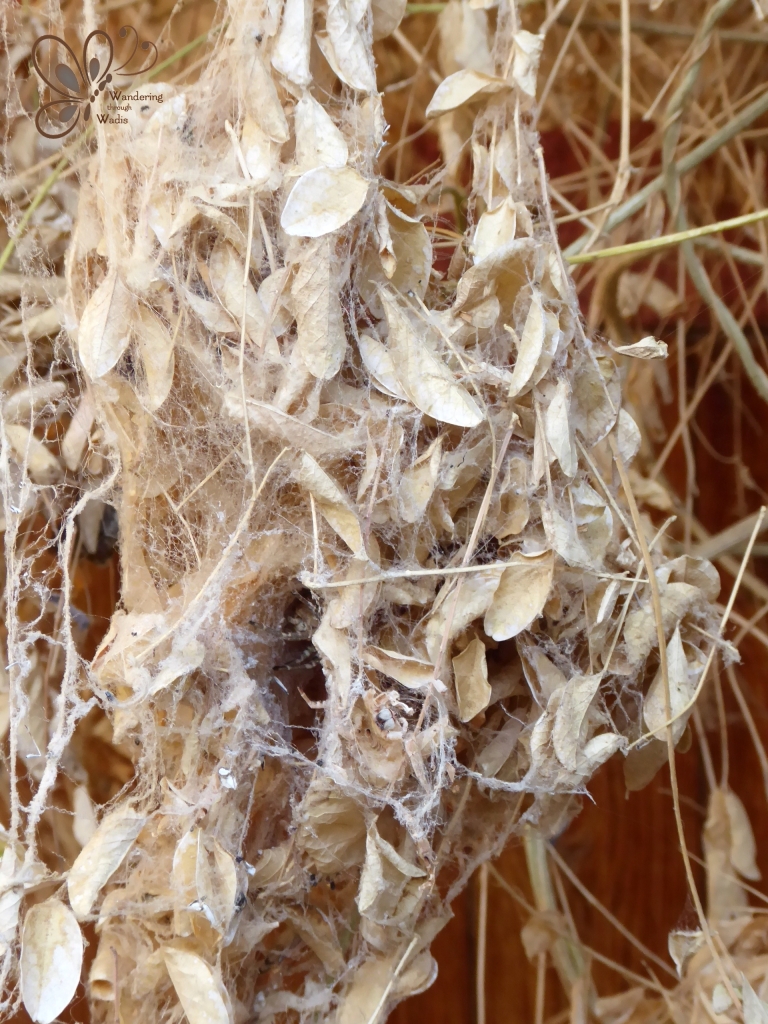
Egyptian Pink Velvet Spiders are typically solitary critters, living alone in separate nests. They build their silken nests in vegetation and prefer higher places in the wind and sun. The webs are cluttered with plant debris. Can you spot the spiders in the nests below?

The spiders feed mostly on flies (which is one reason they are welcome in my house), but will also eat wasps, ants, butterflies, moths, lacewings, antlions, and beetles.

The Velvet Spiders in my garden eat a lot of African Caper White Butterflies (Belenois aurota). The Velvet Spiders use the stickiness of their webs and their venom to subdue their prey.

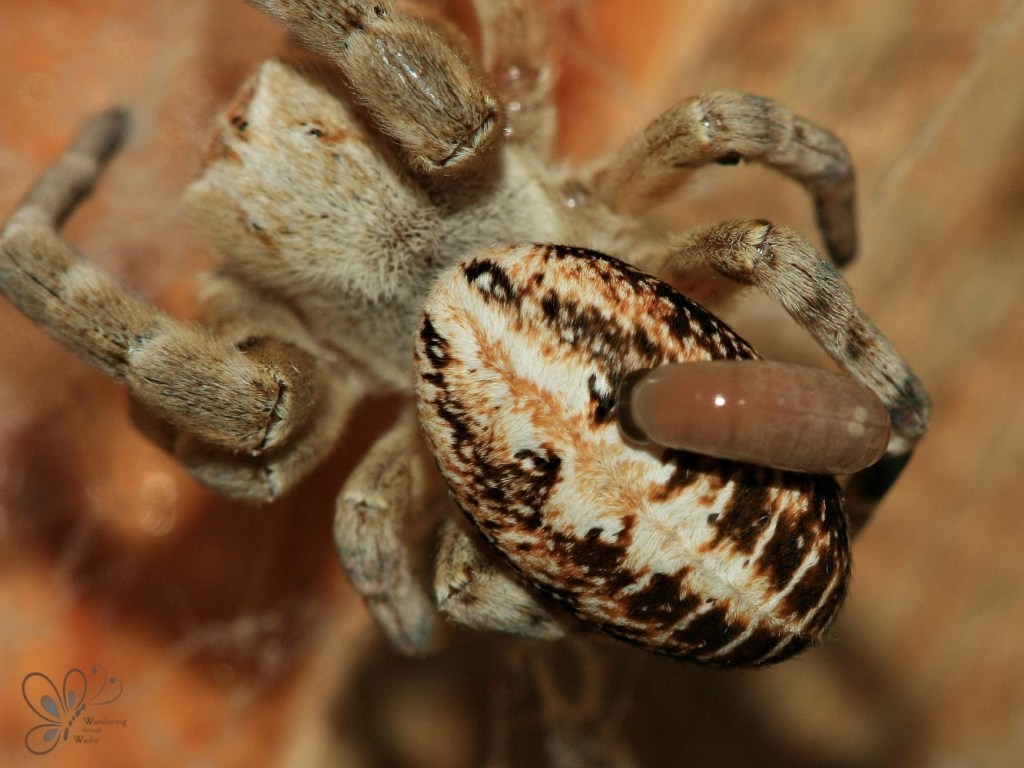
Female Egyptian Pink Velvet Spiders create a round, light yellow-colored egg sac that they keep under their back legs. Spiderlings cannot emerge from this sac on their own; the mother uses her fangs to open the sac.

The mother feeds her young spiderlings by regurgitation for several days. Then she uses her silk to close the entrance to the nest, feeds herself to her spiderlings and they suck her body dry, a behavior known as matriphagy.

Before feeding themselves to their young, Egyptian Pink Velvet Spiders may also be preyed upon by Oriental Hornets (Vespa orientalis) and Mole Crickets (Gryllotalpa gryllotalpa). The spiders can also be killed by pompilid wasps. These wasps, in the Pompilidae family, are also known as spider wasps or spider-hunting wasps because they capture spiders for their larvae to feed on. When the wasp finds a spider, they attack, paralyze it and carry it back to their larvae. Some pompilid wasps, however, after paralyzing the spider, lay their egg inside the spider’s body. When the larva hatches, it emerges from the spider’s body and eats it. Then the larva will spin itself a cocoon in which to complete its metamorphosis into an adult wasp. Many years ago, one of my Freds was a victim of a spider wasp.
Sad, but fascinating!

Do you have any pet spiders?

References:

El-Hennawy, H. & Mohafez, M. (2003). Life history of Stegodyphus dufouri (Audouin, 1825) (Arachnida: Araneida: Eresidae) in Egypt, A step on the way from asocial to social. Serket vol. 8(3): 113-124.

Camel Spider

Camel spiders, sun spiders, barrel spiders, wind scorpions – all of these common names for Galeodes arabs are misleading as these fascinating critters are neither spiders nor scorpions but rather solpugids, a group of arachnids in the order Solifugae. More appropriately, they are also commonly known as Egyptian Giant Solpugids.

You may have heard of them; camel spiders have been the subject of many urban legends about their size, speed, and appetite. Despite knowing that they posed no threat to me – they are not venomous but can inflict a painful bite – seeing my first one last weekend in Wadi Kid still kind of creeped me out, partly because it was as big as my hand!

Camel spiders can grow up to 15 cm long. They have eight legs, as do most arachnids, plus two large pedipalps, or sensory appendages, in the front that look like legs. (The one I spotted was missing its front right leg.) These pedipalps have a “friction-based adhesive quality” that allows the them to grasp their prey and climb smooth surfaces.1 Camel spiders have one pair of small eyes on the top of their heads and, with their eight legs, can move quite quickly – up to 16 kph!

These solpugids are voracious predators and eat insects, rodents, lizards, and even small birds. Their favorite prey are grasshoppers though. Camel spiders have two powerful chelicerae, or jaws, that they use to chop or saw their prey into a pulp. They begin by partially severing the neck, using one pair of chelicerae to hold the prey and the other to cut. Alternating the movements quickly between the two pairs of chelicerae, they continue along the whole body. At the same time, they use regurgitated digestive fluids to liquefy the flesh and suck up the nutrients. (And if this doesn’t sound too horrifying to you, visit the first link in the resources given below to read about their mating practices!)

These two distinctive jaws give rise to the name used by the Jebeliya Bedouin for camel spiders – abu hanakain, the father of two mouths.

Solifugae, the order these camel spiders belong to, means those who flee from the sun in Latin. These solpugids often seek shade from the intense desert sun in a person’s shadow and may seem to be “chasing” a person, but really all they want is a break from the heat.

Have you spotted any Egyptian Giant Solpugids during your wanders through South Sinai?

Resources:

1 – Bittel, J. (2017, August 9). Camel Spiders are Fast, Furious, and Horrifically Fascinating. Smithsonian Magazine.

National Geographic – Camel Spider

Aly, D. & Khalil, R. (2011). Wildlife in South Sinai. Cairo. Funded by the E.U. in cooperation with G.O.S.S.

Huntsman Spider

I have not been able to photograph a huntsman spider yet, but a friend in St. Katherine has and generously shared her pictures so I could write a post about this beauty!

This is a spider in the huntsman family of spiders (Sparassidae), specifically Eusparassus walckenaeri. There are 33 spiders in the Eusparassus genus, and they can be found in Africa, Asia, Europe, and Peru. Huntsman spiders are known for their incredible speed. In fact, it’s because of their lightning speed that the Jebeleya Bedouin call them beraira.

These huntsman spiders are large with flat bodies that are dark brown to orange-brown in color, with a pattern of spots and chevrons. The bodies can be from 1 to 2.5 cm in length, with the females being larger. The legs have dark bands of color and, although the legs of most spiders are perpendicular to their bodies, the legs of huntsman spiders are not. Their legs are angled and twisted in such a way that they move with a sideways crab-like motion. (Huntsman spiders are sometimes called giant crab spiders.)

Huntsman spiders are nocturnal hunters and feed on small and large insects, especially cockroaches, so a spider would be a welcome find in your home! And there’s no reason to be afraid of them; their venom won’t hurt you.

While these spiders may be imposing hunters, they are, of course, prey to other animals, especially to a family of wasps known as “spider wasps” (Pompilidae). A female spider wasp uses its venomous sting to paralyze a spider and then drags the spider to her nest or burrow. There, she lays an egg on the spider, which is anesthetized but alive. The wasp larva hatches and proceeds to feed on the spider, saving the vital organs for last, until it finally spins a cocoon and eventually emerges as an adult wasp.

These huntsman spiders can be found in open ground, but I have never spotted one in the wadis. They can also be found indoors and I’m pretty sure I have seen (some species of) huntsman spiders scuttle through the communal seating area of a camp in Ras Sidr. Have you spotted these huntsman spiders in South Sinai?

Resources:
Aly, D. & Khalil, R. (2011). Wildlife in South Sinai. Cairo. Funded by the E.U. in cooperation with G.O.S.S.

Common Black Scorpion

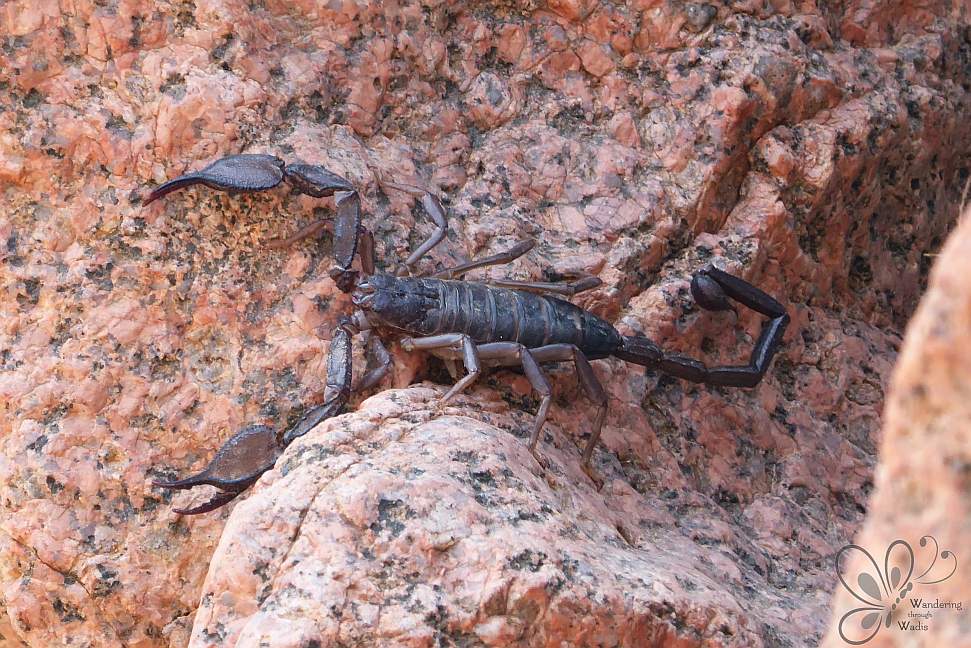
In all my time in the deserts and wadis of South Sinai, I have encountered scorpions only twice. And that’s okay with me. They kind of creep me out, just like their arachnid cousins, spiders, used to. But I’ve learned to love spiders and so maybe one day I’ll feel differently about scorpions too. Indeed, I was simultaneously freaked out and fascinated when we encountered this Common Black Scorpion (Nebo hierichonticus) in a wadi last spring.

Common Black Scorpions can grow up to 11 cm in length, not including the tail. Their color ranges from light or reddish brown to dark brown with their legs and large pincers being slightly lighter in color.

I was relieved, once I was able to identify this scorpion, to learn that while their venom is quite toxic, causing hemorrhage and necrosis to small prey, their stings are generally harmless to humans, being compared to the sting of a honeybee. The scorpions prey mainly on big insects and spiders and sometimes on small vertebrates like geckos.

Common Black Scorpions live in and under big stones and rocks or in cracks and burrows in deserts and arid mountainous regions.

Sinai is home to a variety of scorpion species, including two of the most dangerous in the world – the Arabian Fat-tailed Scorpion (Androctonus crassicauda) and the Death Stalker (Leiurus quinquestriatus). You can also find Egyptian Pillar-tailed Scorpions, Egyptian Sand Scorpions, and Large-clawed Scorpions in Sinai, although this list is not exhaustive.

The Bedouin of South Sinai “have devised their own version of a primitive vaccine that is believed to provide their children with immunity against venomous stings of scorpions and wasps.” The process of immunization differs among tribes, but for the Jebaliya tribe, it involves collecting, roasting, and grinding a spider wasp and a young Death Stalker scorpion along with a bit of sugar. To this powder, spit from someone believed capable of passing on their immunity is added. This mixture is then given to a child sometime before they eat their first solid food.*

References:

*Aly, D. & Khalil, R. (2011). Wildlife in South Sinai. Cairo.Funded by the E.U. in cooperation with G.O.S.S.

Jericho Scorpion – Nebo hierichonticus – Mahmiyat.ps