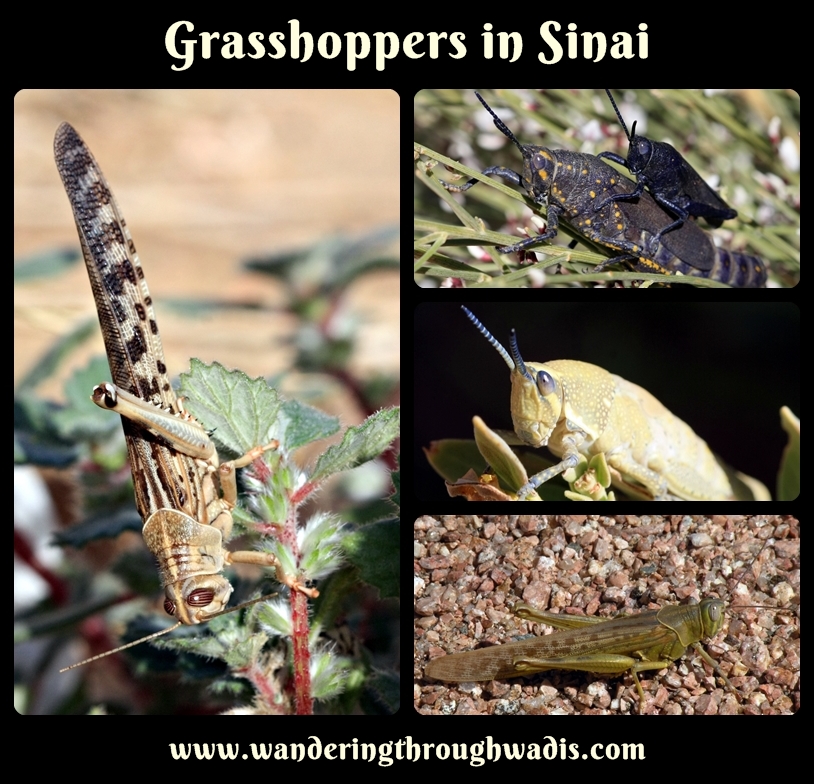
Grasshoppers belong to the order Orthoptera, which also includes locusts and crickets. Worldwide, there are more than 20,000 species in this order. In this image, you can see:
The Cone-headed Grasshoppers are very common in the wadis around Dahab, both in their black adult phase and their pale/yellow colored nymph phase. And are often seen mating, the large female carrying the smaller male on her back.
The small and stocky Golden Spiny Mouse (Acomys russatus), called fa’r abu shawk dhahabi in Arabic, is named for its spiny, golden-orange colored fur that runs from its head to the base of its tail.
They use this spiny fur as part of their defense system, erecting the spines to appear larger than they are to predators, which include birds of prey, owls, and snakes. They will also bite to defend themselves.
Its blackish tail is shorter than its body. They have black ears with a white patch of fur behind each ear. Their underside is pale-colored, their legs gray, and their feet pale with black soles. They have a distinct white spot below their eyes.
Golden Spiny Mouse in Wadi Gharba
Golden Spiny Mice do not make burrows, but rather live in rock crevices and among boulders. They are more strictly found in arid and rocky areas than their cousins, the Cairo Spiny Mice (Acomys cahirinus), which are also found in Sinai. Golden Spiny Mice are also diurnal and more likely to be seen during the day than their cousins.
These rodents are omnivorous and are reported to eat plant matter, seeds, dates, grains, and insects like moths and grasshoppers, but also spiders, scorpions, and dung.
I spotted the Golden Spiny Mouse in the video above in Wadi G’Nai and watching him try to get all the goodies out of the caper fruit was quite entertaining! These mice can even be found at the top of Gebel Musa.
Have you ever spotted one of these cute fellows in South Sinai?
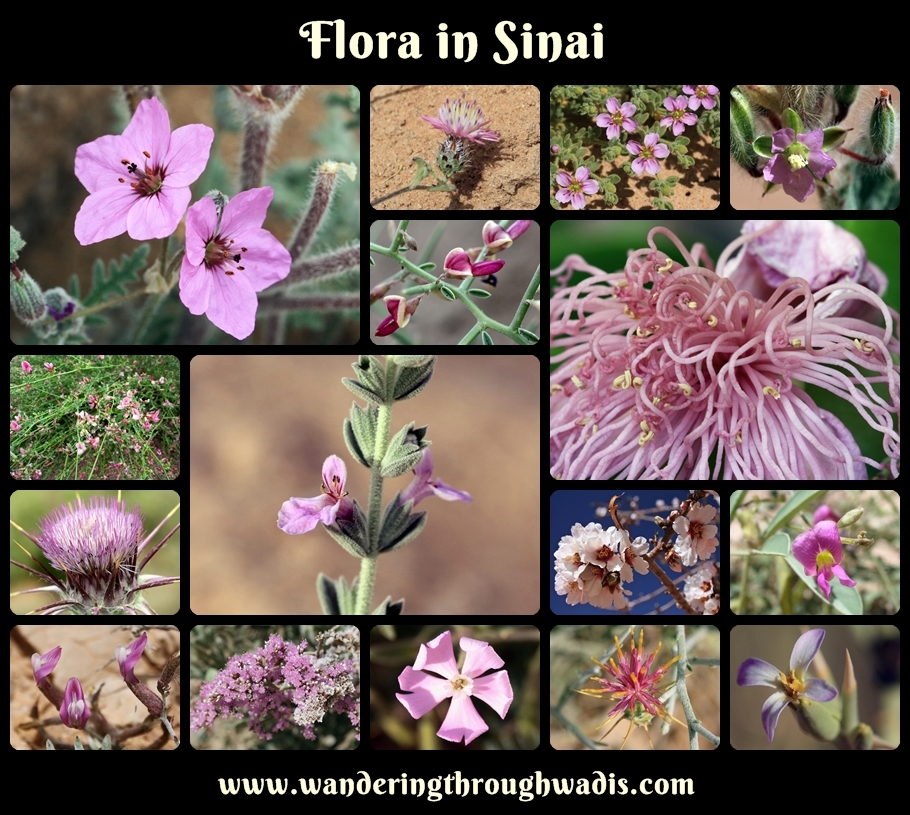
This collection includes one of my absolute favorite blooms – those on a caper bush! While they start off completely white, their color changes to pink and then a dark purple. Read about capers in this previous post.
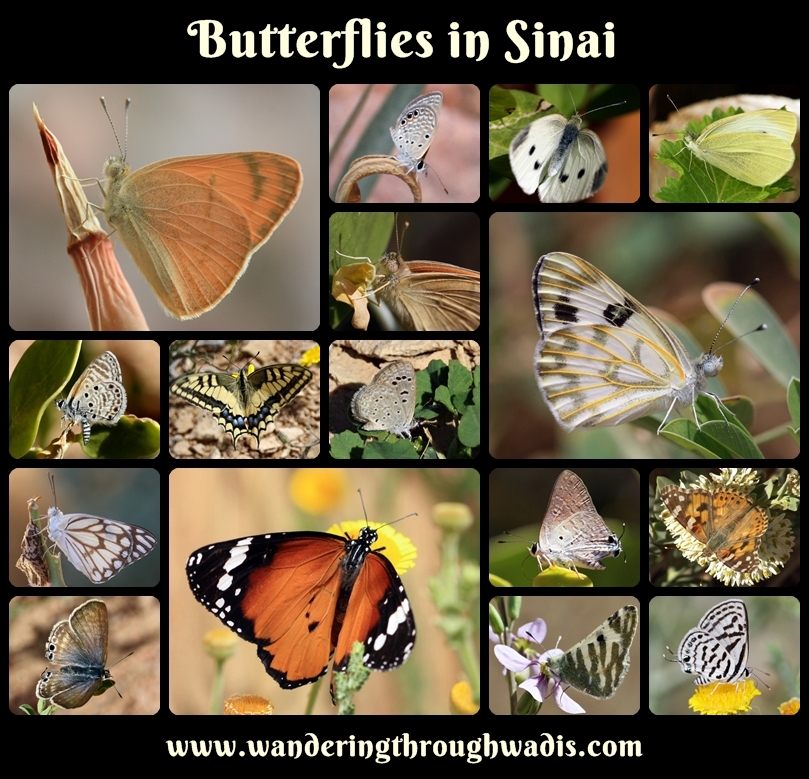
Butterflies! I love them. I am enthralled by their process of metamorphosis. Over the years, I have raised dozens of them indoors and watched them grow and change from tiny caterpillars to delicate chrysalises to beautiful butterflies. Often I share this experience with my students, who are as fascinated as I am, learning along with them.
I am able to identify most of the butterflies I spot thanks to the book Butterflies of Egypt: Atlas, Red Data listing & Conservation by Francis Gilbert and Samy Zalat. You can download the book for free here. Many thanks to the authors for sharing this amazing resource!
In the photo collection above, you can see:
Large Salmon Arab (Colotis fausta) Grass Jewel (Chilades trochylus) Small White (Pieris rapae) African Babul Blue (Azanus jesous) Saharan Swallowtail (Papilio saharae) Dark Grass Blue (Zizeeria karsandra) Desert White (Pontia glauconome) African Caper White (Belenois aurota) African Monarch (Danaus chrysippus) Pomegranate Playboy (Deudorix livia) Painted Lady (Vanessa cardui) Long-tailed Blue (Lampides boeticus) Scarce Green-striped White (Euchloe falloui) Mediterranean Tiger Blue (Tarucus rosaceus)
“Sinai is one of the very few places in the world (and it may be unique) where no social bees of any kind occur naturally, only solitary bees…Recently hives of domesticated social honeybees have been brought in from Egypt, and scientists are worried about their impact on the wild bees, and hence on the efficiency with which native plants are pollinated. ” ~ Gardens of a Sacred Landscape: Bedouin Heritage and Natural History in the High Mountains of Sinai by Samy Zalat and Francis Gilbert
Pictured here:
Top Right: Carpenter Bee (Xylocopa sp), which you can learn more about in this post.
Bottom Right: Leafcutter Bee (Coelioxys sp), which you can learn more about in this post.
There have been several reports in the past year of hives of social bees in Dahab and Nuweiba. After reading the book quoted above, I have been fascinated about their possible impact on the native solitary bees and plants, so I did a bit of research and found two very interesting articles:
Sinai Wild Bees Under Threat (Scientists warn against the negative impact of honeybees’ introduction on wild bees and native plants in South Sinai.)
Human interference in the natural order of our ecosystems is not always a good thing. I’ll be thinking twice now about buying honey from St. Katherine’s…
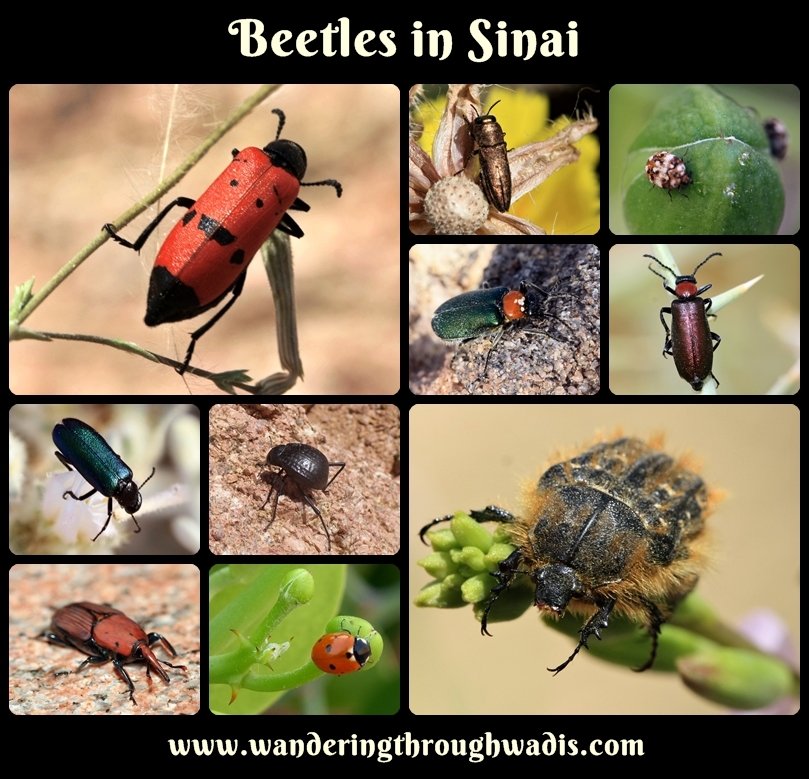
Beetles, forming the largest order of insects with nearly 400,000 identified species, account for nearly 40% of all insects. So I guess it’s no surprise that my collection of beetle images is one of my largest!
Here’s what you can see in this sampling:
Blister Beetle
Carpet Beetle
Darkling Beetle
Red Palm Weevil
Seven-spotted Ladybug
Hairy Rose Beetle
Jewel Beetle
and a few unidentified beetles (the blue/green ones…can anyone help with an ID?)






 Wandering through Wadis