Black Cone-headed Grasshopper

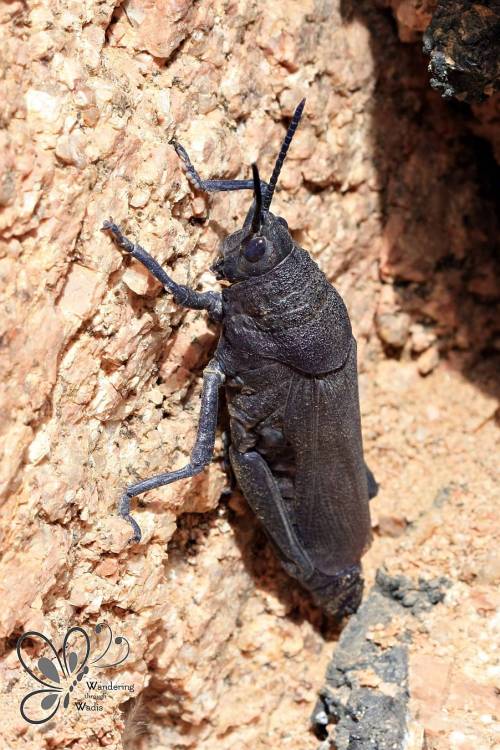
Unlike the Egyptian Flower Mantis, the Black Cone-headed Grasshopper (Poekilocerus bufonius), with its large black body and slow movement, is easy to spot!  Especially when they are resting on the rocks.

Wadi Kostya (2)

But these grasshoppers feed on plants in the milkweed family, which produce toxic chemicals. Ingesting these plants make the grasshoppers poisonous and distasteful to predators. When they are attacked, Black Cone-headed Grasshoppers spray a toxic fluid in defense. In Arabic, they are called zagat, meaning “the one who sprays toxins onto girls’ faces”.

IMG_3613

You’ll most often find these grasshoppers on Pergularia tomentosa plants. Many Bedouin, before sitting down near one of these plants, will throw stones at the bush to scare off any grasshoppers. Sometimes these plants will be home to many grasshoppers. How many can you count in the picture below?

Wadi Jiddy_Nov2010_01

I’ve also spotted Black Cone-headed Grasshoppers on ajram (Anabasis sp.), harjal (Solenostemma arghel), reseda  (Reseda sp.), broom (Retama raetam) and other plants.

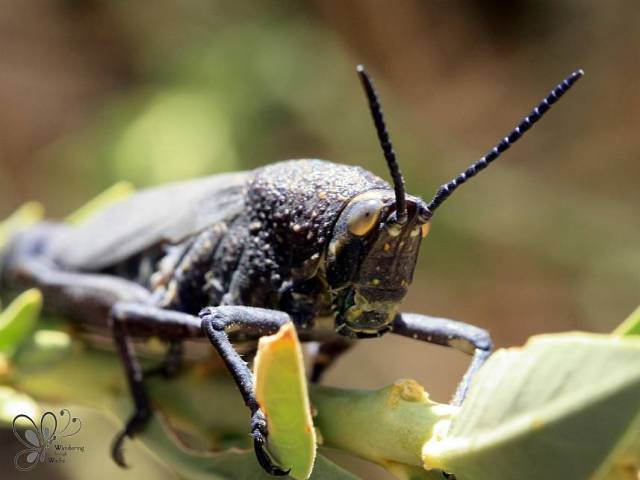
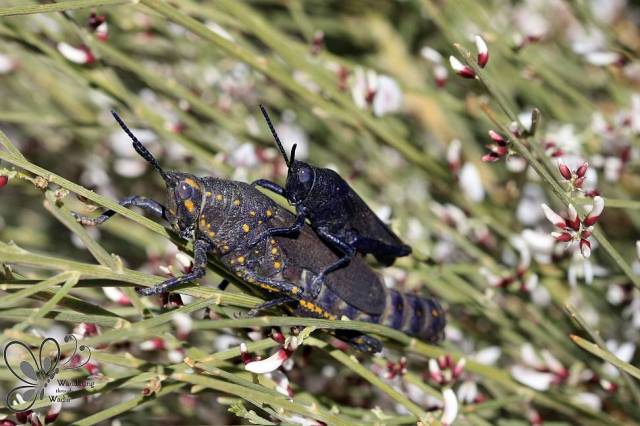
The adults that I’ve seen have been between 6 – 10 cm in length. They are black or dark-colored, sometimes with yellow spots. I’ve noticed orange underwings on several.

Wadi Kostya_Feb14 (20)

Females are substantially larger the males, as you can see in the photo of the mating pair below.

Bir Safra Area (73)

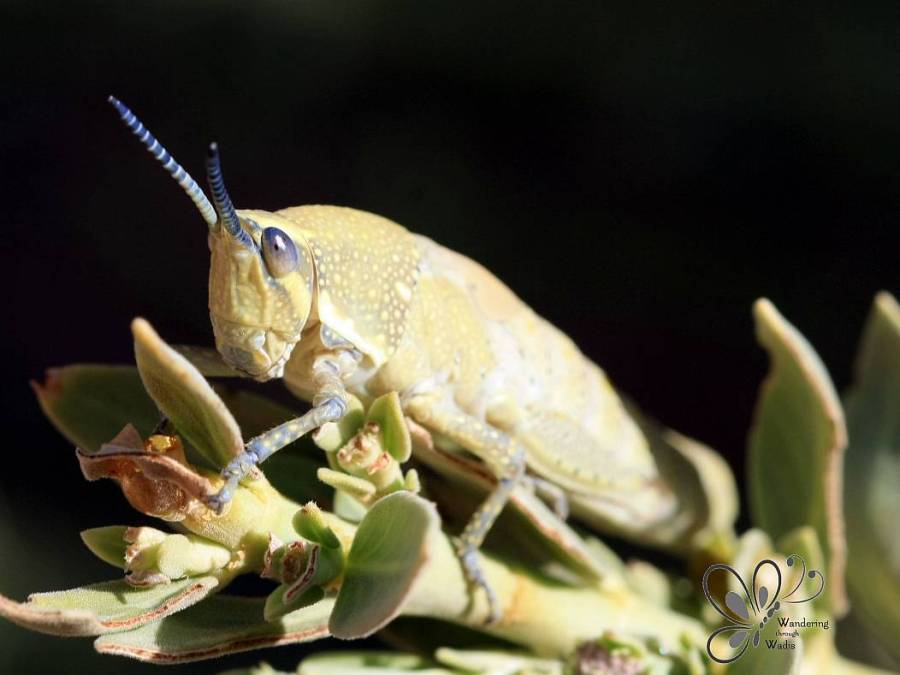
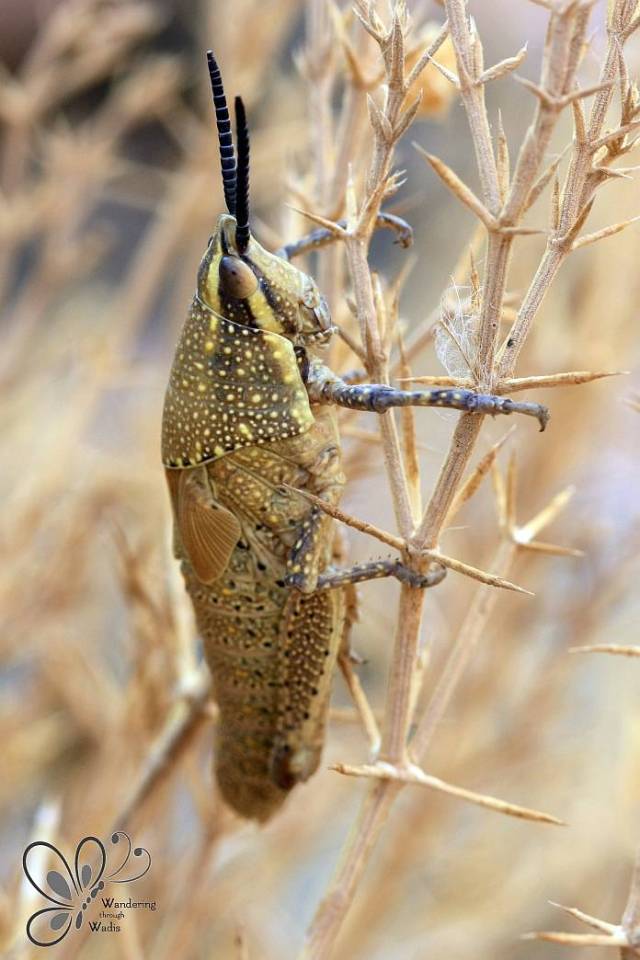
As is typical of this order of insects (Orthoptera), the grasshoppers go through incomplete metamorphosis. The young nymphs resemble the adults but have no wings and can have extremely different colors. Look at these beautiful yellow ones!

IMG_3618

As they age, they will shed their exoskeletons several times, growing wings until their final molt into a mature adult with fully-developed wings.

Wadi Connection_Feb15 (52)

I’ve spotted Black Cone-headed Grasshoppers from late fall through spring in many of the wadis around Dahab, as well as higher up near Wadi Arada (on the way to St. Katherine’s). They are one of the first critters we came across on our early wadi wanderings and I always enjoy seeing them. And photographing them! They stay so still for so long, making excellent models. 🙂

References:

Aly, D. & Khalil, R. (2011). Wildlife in South Sinai. Cairo.Funded by the E.U. in cooperation with G.O.S.S.

Zalat, S. & Gilbert, F. (2008). Gardens of a Sacred Landscape: Bedouin Heritage and Natural History in the High Mountains of Sinai. Cairo: The American University in Cairo Press.

Egyptian Red Fox

The Egyptian Red Fox (Vulpes vulpes aegyptiacus) is the largest fox in Egypt and one of three species of fox occurring in Sinai. I’ve never spotted a fox while wandering through wadis [UPDATE: I have now! See the extra pics below.], but over the years I’ve spotted several from moving vehicles. Always magical to see! But difficult to capture with a camera. (Especially if you’re the one driving.) One night, though, we were treated to a visit by a fox – a fox intent on stealing some fish!

Egyptian Red Fox (2)

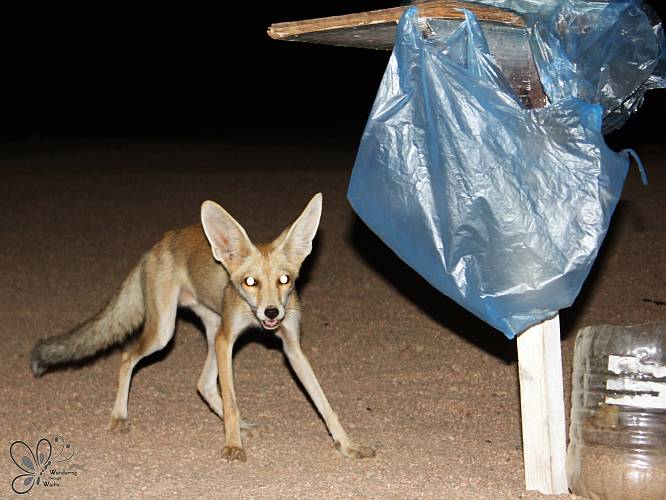
We had driven up one of the wadis behind Dahab with Eid, a Bedouin friend, who had promised to make us a traditional meal cooked over a campfire. (You can read more about the watermelon fettah here. It was delicious!) As the men were preparing the food, this fox came inching closer and closer, drawn by the scent of fish. Eid put the fish on a small raised platform to keep it away from the fox but that didn’t deter it.

Egyptian Red Fox (1)

The fox also didn’t seem bothered by the flash from my camera. He was persistent, but the fox never did get the fish and was eventually shooed away by Eid’s young son.

Egyptian Red Fox (4)

The Egyptian Red Fox lives elsewhere in Egypt and only relatively recently did they expand into South Sinai, most likely related to the increasing spread of human activity. These foxes are not foxes of true deserts. They inhabit vegetated wadis, farmland, gardens, and desert margins. We spotted this Red Fox several years ago, when tourism in Dahab was booming and this wadi was a popular destination for tourists to enjoy a desert dinner. Our Bedouin friend said this helped explain why the fox was around, feeding on leftovers, and not so scared of humans.

The foxes are nocturnal and eat insects, small rodents, fish, fruit, and vegetables. In Ras Mohamed, they are known to dig for crabs.

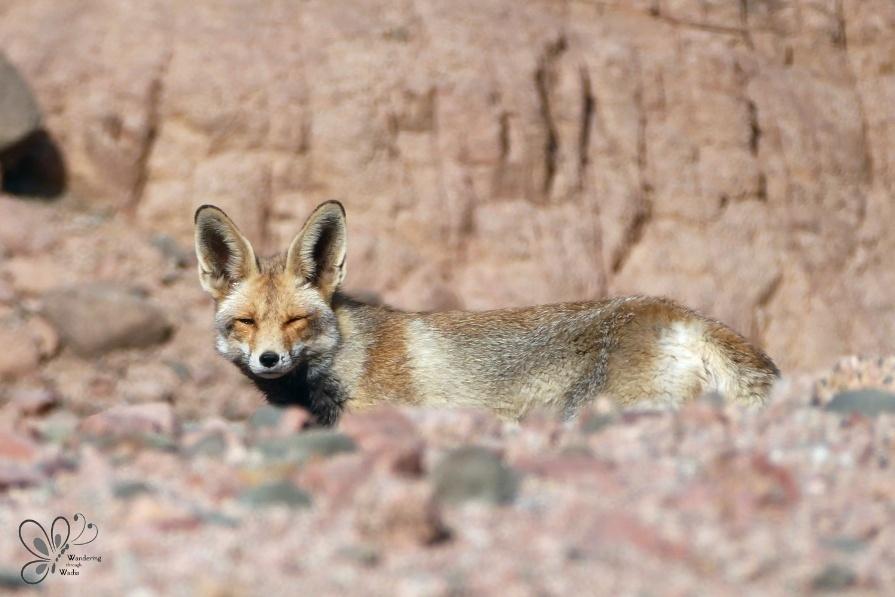
Although they are commonly called Red Foxes, this subspecies is not red, but more of a ruddy grey-brown. They have large ears and the hair on the back of the ears is black. Their tails are bushy and white-tipped and they have a darker-colored streak that runs from their muzzle to their eyes. Facial markings are a distinguishing feature among foxes and so can help identify the species. I am no expert, of course, and at first had thought this was a Rüppell’s Sand Fox, another species found in Sinai, but I have learned that the Sand Foxes have very distinctive black marks under their eyes. Tail color and proportion is another distinguishing feature; the Blanford’s Fox, also found here, has the longest tail of Egyptian foxes and it’s dark-tipped.

If you’re like me, though, you’ll be delighted to spot a fox in South Sinai, no matter what the species!

UPDATE: We encountered a beautiful fox in Wadi Um Ma in January 2018. We were able to watch him from a distance for several minutes before we went our separate ways.

References:

Hoath, Richard. (2003). A Field Guide to the Mammals of Egypt. Cairo: The American University in Cairo Press.

Ornate Spiny-tailed Lizard

It was tough deciding which cool creature I should feature first, but recent discussions on Project Noah had me thinking about Dhabb lizards, so they won!

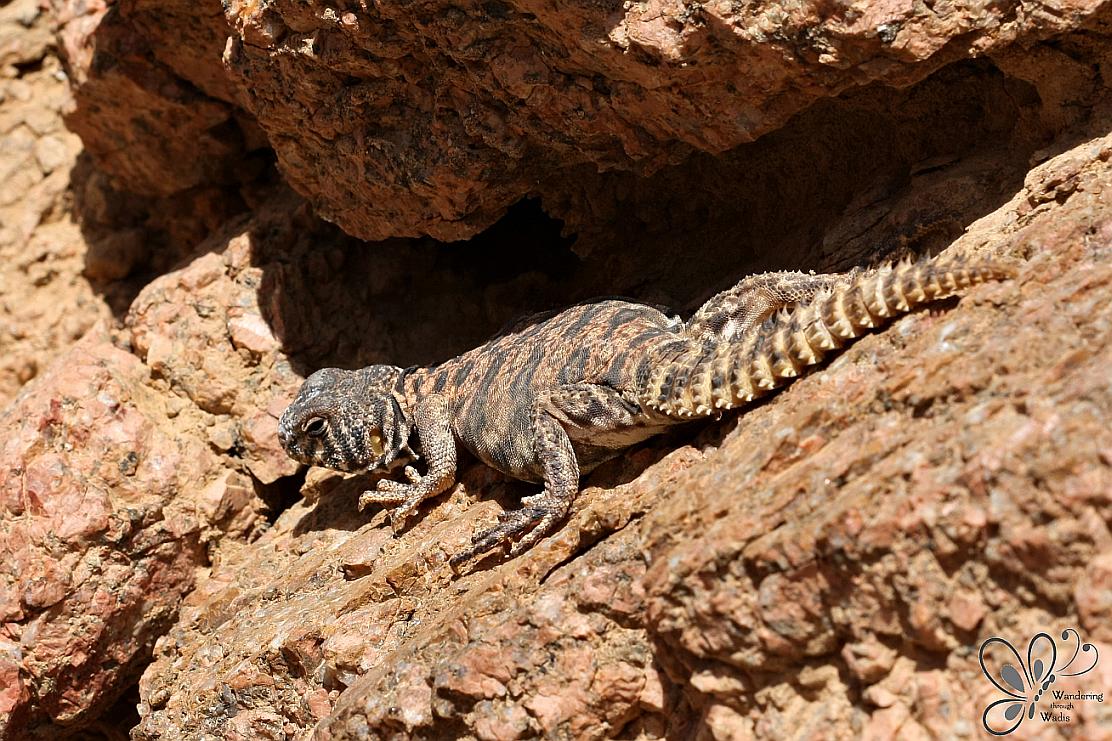
Ornate Spiny-tailed Lizards (Uromastyx ornata), also called Dhabb Lizards, are one of the larger animals you’ll come across in the wadis of South Sinai, their bodies growing up to 20 cm in length. Dhabb lizards like to bask in the hot desert sun. Males choose a highly visible position to declare their territory to other Dhabbs and to be on the lookout for intruders. If you’re on the lookout while hiking, you can sometimes spot these lizards ahead of you on the rocky sides of the wadis.

IMG_3064

If you proceed slowly and quietly, the lizards will sometimes let you approach and get a closer look.

IMG_3115

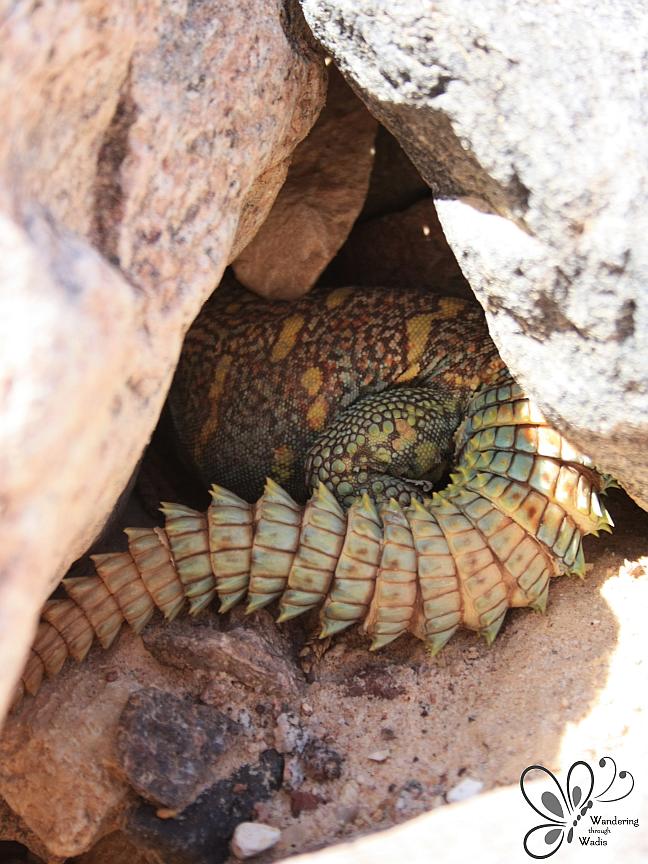
But often, when they hear you coming, the lizards scramble on their short, powerful legs into a rocky crevice and all you see is their very distinctive spiny tail.

IMG_6027

Male Dhabbs, like those pictured above, have blue heads and greenish blue backs with bands of black-edged yellow spots. The female and juvenile lizards sport a similar pattern but in reds, browns, and greys. Their coloration overall, however, can vary quite a bit depending on age, sex, and breeding condition.

IMG_3230

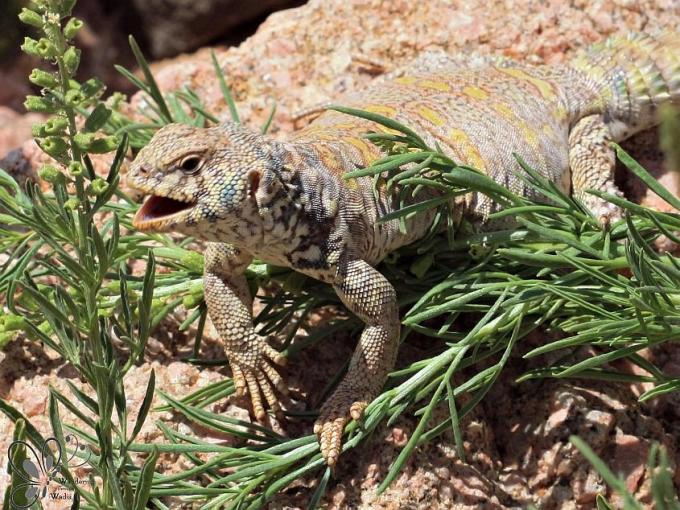
Ornate Dhabb lizards are active during the day and they are most active at midday during the hottest months of the year. They are herbivorous, munching mainly on the leaves, seeds, and flowers of desert plants. Occasionally, they might feed on invertebrates like insects and spiders.

A few years ago, while hiking one of our regular routes, my husband and I came across a Dhabb lizard feeding on the lush desert plants underneath an acacia tree. (There had been a bit of winter rain so the wadis were quite green with vegetation. And Dhabbs are strongly associated with acacias.) The Dhabb did not seem bothered by our presence and carried on eating as I sat on a nearby rock with my camera . What a treat it was to be able to watch!

Geocache Dabb (53)

Ornate Spiny-tailed Lizards are listed as a species of Least Concern on the IUCN Red List of Threatened Species. However, the Red List justifies this classification, recognizing that the lizard has gone locally extinct in parts of Egypt and Israel but continues to thrive as a species in Saudi Arabia. The lizards are heavily collected by animal traders despite the fact that exporting this species is illegal in Egypt. In Sinai, Dhabb lizards are also threatened by loss of habitat due to tourist activities, removal of acacia trees for charcoal making, quarrying, and general development.

So, please remember, when visiting Sinai’s spectacular deserts:

Take nothing but pictures,
Leave nothing but footprints,
Kill nothing but time.

Geocache Dabb (46)

References:

Wilms, T. & Sindaco, R. 2012. Uromastyx ornata. The IUCN Red List of Threatened Species 2012:e.T198538A2531743.http://dx.doi.org/10.2305/IUCN.UK.2012.RLTS.T198538A2531743.en. Downloaded on 08 May 2016.

Baha El-Din, Sherif. (2006).  A Guide to the Reptiles and Amphibians of Egypt. Cairo: The American University in Cairo Press.

Ornate spiny-tailed lizard (Uromastyx ornata)  on Arkive.org