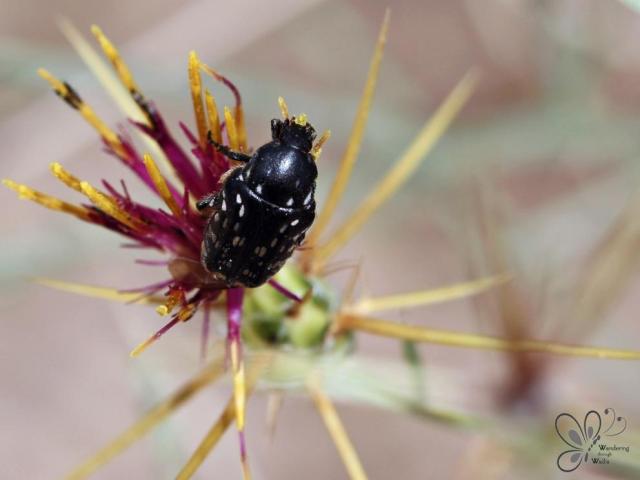
Time to finally feature my favorite bird – the European Bee-eater (Merops apiaster)! I fell in love with these birds when I lived in Cairo, where I enjoyed watching them from the balcony of my sixth-floor apartment. These bee-eaters are passage migrants through Egypt in the spring and autumn. They spend winters in tropical Africa and then head north to their breeding grounds in Europe, northern Africa, and western Asia. Their arrival in Egypt in late March or early April marks the official start of Spring for me. When I first spot them, I send a message to my father living in Italy and then, several weeks later, he lets me know when he first sees them there. It’s become a fun tradition!
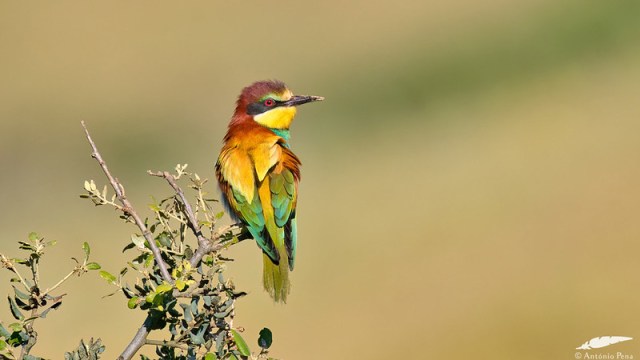
European Bee-eaters are also known as Golden Bee-eaters because of their beautiful coloration. In Sinai, the Jebeliya tribe call them banat barik in Arabic, meaning “sparkling girls”. Bee-eaters are slender birds with chestnut-colored crowns and mantles, bright yellow throats and lower backs, and rich turquoise blue breasts and bellies. They sport a black face mask and breast band that divides their yellow throat from their blue breasts. Males and females look similar, but the females tend to be slightly paler and less colorful. Although quite distinctive, it is possible to confuse these European bee-eaters with their beautiful cousins, the Blue-cheeked Bee-eaters (Merops persicus).

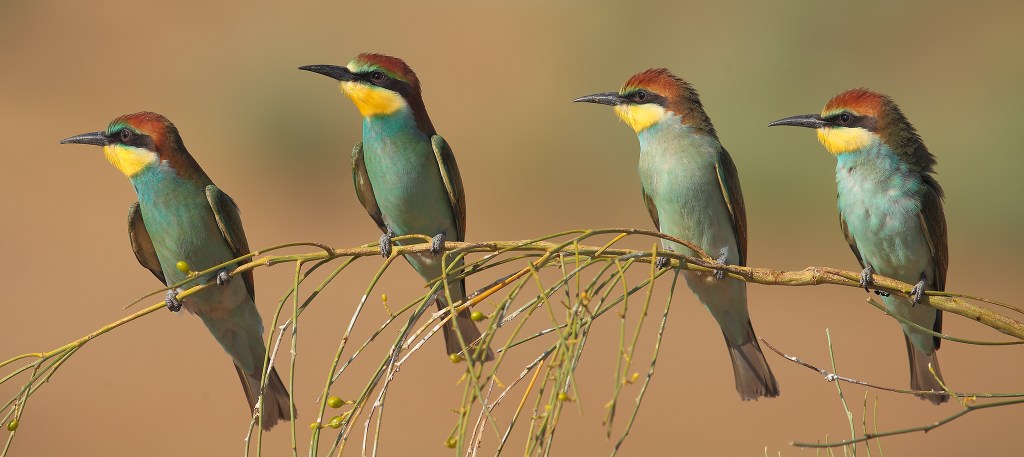
Gregarious, bee-eaters occur in flocks – feeding, roosting, and nesting in groups. Their characteristic flight call, a prroop prroop sound, is what alerts me to their presence overhead. Bee-eaters are graceful fliers, effortlessly gliding and swooping in a manner similar to swallows. They hunt insects on the wing (during flight), typically feeding 1 – 3 hours after sunrise and 2 – 3 hours before sunset, times when you are most likely to hear their calls or spot small groups circling overhead in flight.
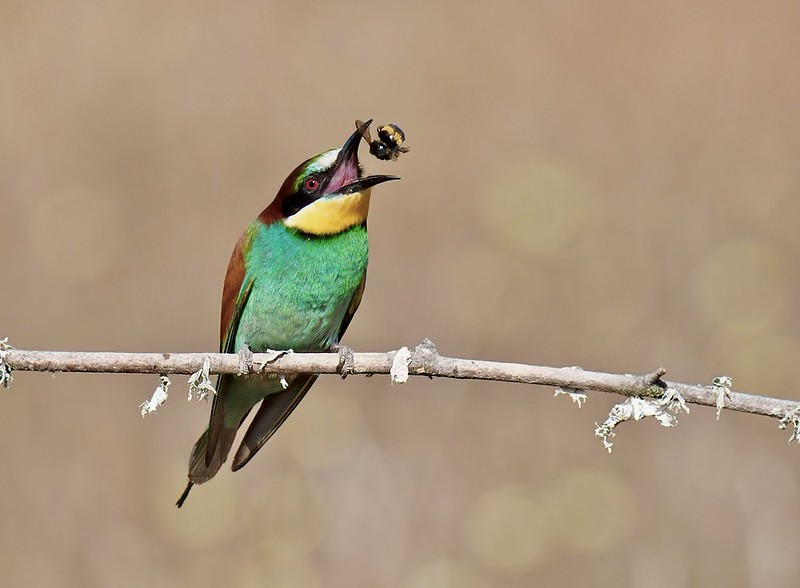
As their name suggests, they feed on bees, but their prey ultimately depends on weather conditions, region, and breeding season. Hundreds of species have been identified as prey, including wasps, hornets, flies, dragonflies, butterflies, moths, bugs, cicadas, water scorpions, mantids, beetles, grasshoppers, locusts, and winged ants and termites. Some smaller insects are eaten in flight, others are brought back to a perch where the bird beats or rubs the insect against the perch to kill it before tossing it up in the air and swallowing it. It has often been assumed that the birds do this to remove stingers and venom, but this has been shown to be incorrect. Stingers are often swallowed and the venom is not removed. Further research is needed to determine if toxins actually enter the birds’ tissues and whether their colorful plummage is therefore acting as a warning coloration.
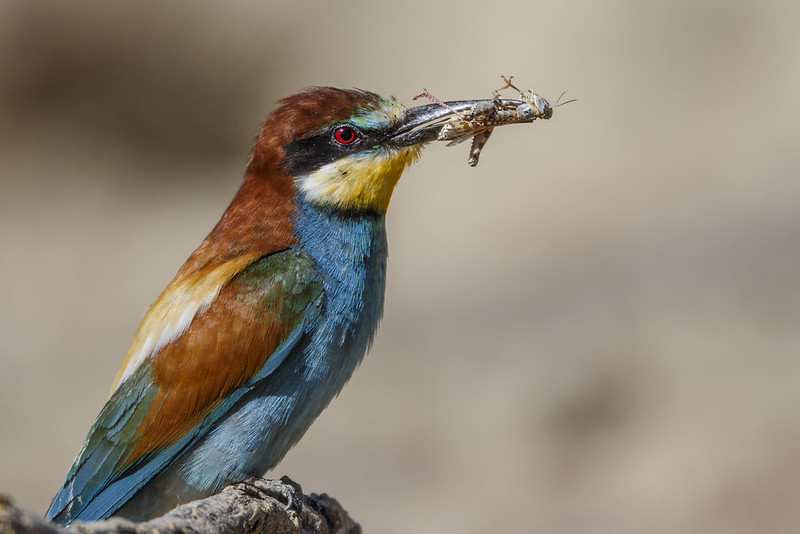
When they aren’t feeding, European bee-eaters spend a lot of their time sunbathing and dustbathing, interspersed with preening, scratching, and stretching.
European bee-eaters are typically monogamous, pair bonds lasting for several years and sometimes for life. Their nests are tunnels dug into steep walls, vertical banks, or trenches. Each tunnel is about 1.5 – 2 m long and are excavated by both sexes. Both males and females care for the eggs.
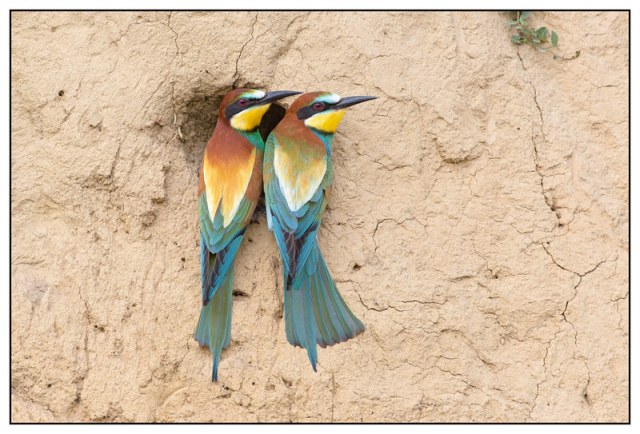
I can hear their calls now as I type this. Have you heard them in Dahab or elsewhere in Sinai?
(If you’re a regular visitor to my blog, Facebook page, or Instagram account, you probably know by now that I am NOT a bird photographer. Many, many thanks to all the talented photographers who share their work with Creative Commons licenses.)
References:
Bastian, H.-V. and A. Bastian (2024). European Bee-eater (Merops apiaster), version 3.0. In Birds of the World (S. M. Billerman and B. K. Keeney, Editors). Cornell Lab of Ornithology, Ithaca, NY, USA. https://doi.org/10.2173/bow.eubeat1.03
Tippett RM 2024. European Bee-eater Merops apiaster. Biodiversity and Development Institute. Available online at https://thebdi.org/2024/07/29/european-bee-eater-merops-apiaster/