
Rock Hyrax (Procavia capensis) are not the most commonly spotted creature in the wadis, but they may be the most fascinating!
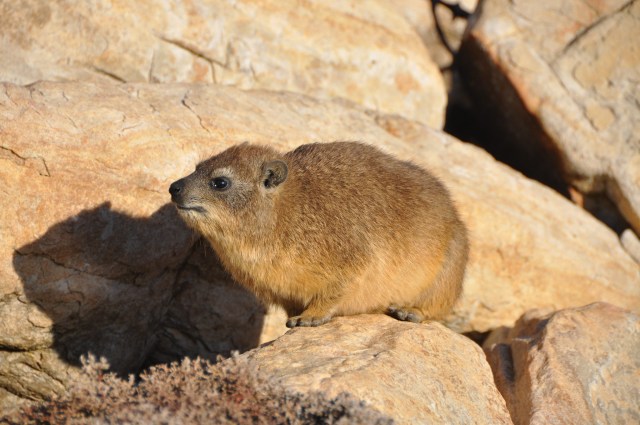
Rock Hyraxes, called wabr in Arabic, are tailless and have small, round ears and a very short neck that gives the impression that their heads have been stuck directly on their bodies. Their short snouts are pointed and have black whiskers. Their eyes are large and dark with a pale patch of fur above their them. The coats are short and dense but longer hairs that are sensitive to touch are scattered throughout.
With their stout, rabbit-like bodies, Rock Hyraxes are often mistaken for rodents (order Rodentia) but they actually belong to the order Hyracoidea, and their closest living relatives are elephants, manatees, and dugongs.
One of their most interesting features are their distinctive feet. The forefoot has four short toes. The hindfoot, however, has three short toes and one elongated one that is separated from the others and has a curved claw that is used to grasp⁴. The soles of their feet are rubber-like and kept moist by glandular secretions which allows their feet to act like suction cups. These structures of their feet make them very adept climbers, perfect for scrambling over the rocky areas and cliffs that they call home.
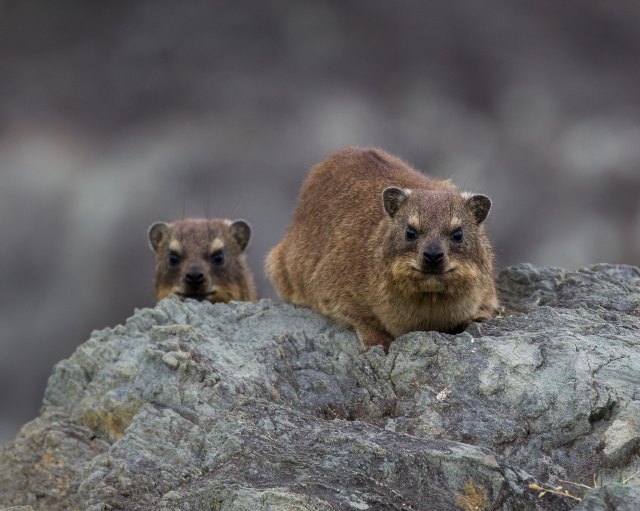
Rock Hyraxes feed mainly on vegetation, predominantly the seeds and leaves of acacia trees, but they may eat a wide range of other food including insects and small reptiles. Juveniles must eat hyrax poop in order to acquire the gut bacteria needed to digest plants. Adults can even eat plants, such as nightshades and spurges, that are poisonous to other animals, and they don’t need to drink water.
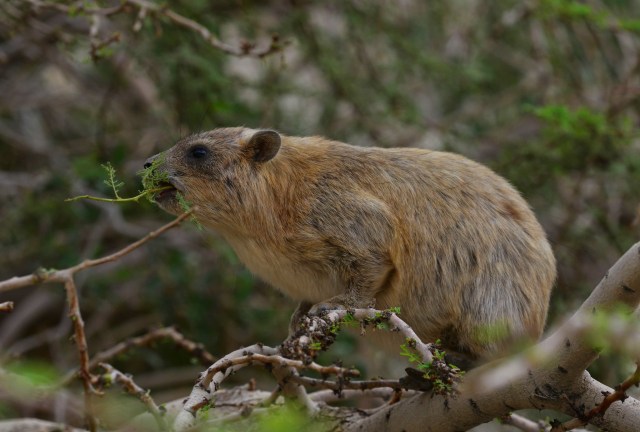
While Rock Hyraxes have excellent sight, hearing, and scent, they are not great at regulating their body temperatures. They will, therefore, bask in the sun during the day or heap together to keep warm.
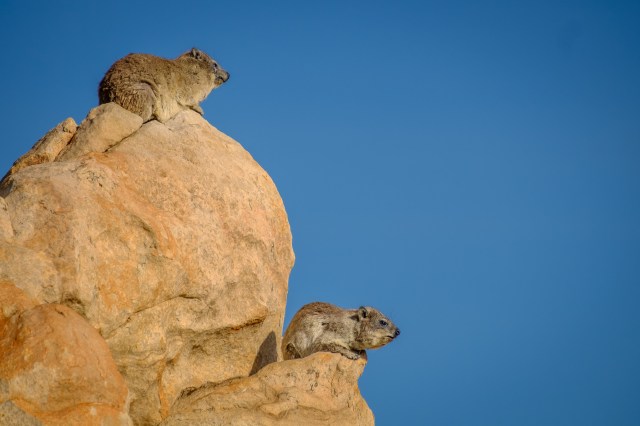
Rock Hyraxes typically live in colonies and can be quite vocal. Several members of the group act as lookouts and use a sharp alarm call to alert others to dangerous predators – birds of prey, jackals, wild cats, foxes, and leopards. Male hyraxes also sing to attract females and apparently those that can keep a more steady beat get more mates.¹
The only Rock Hyraxes I have seen were, many years ago, those kept by Ramadan in his garden in Wadi Arba’een (St. Katherine). I do, however, come across their scat in the wadis around Dahab. Rock Hyraxes use communal latrines, meaning that the waste from all the hyraxes in a colony accumulates in one spot, called a midden. The waste slowly crystallizes into layers, trapping pollen, grains, and other substances similar to amber, fossilized tree resin. For scientists, these Rock Hyrax middens contain evidence of the past that is helping them understand climate change² and possibly even human development³.
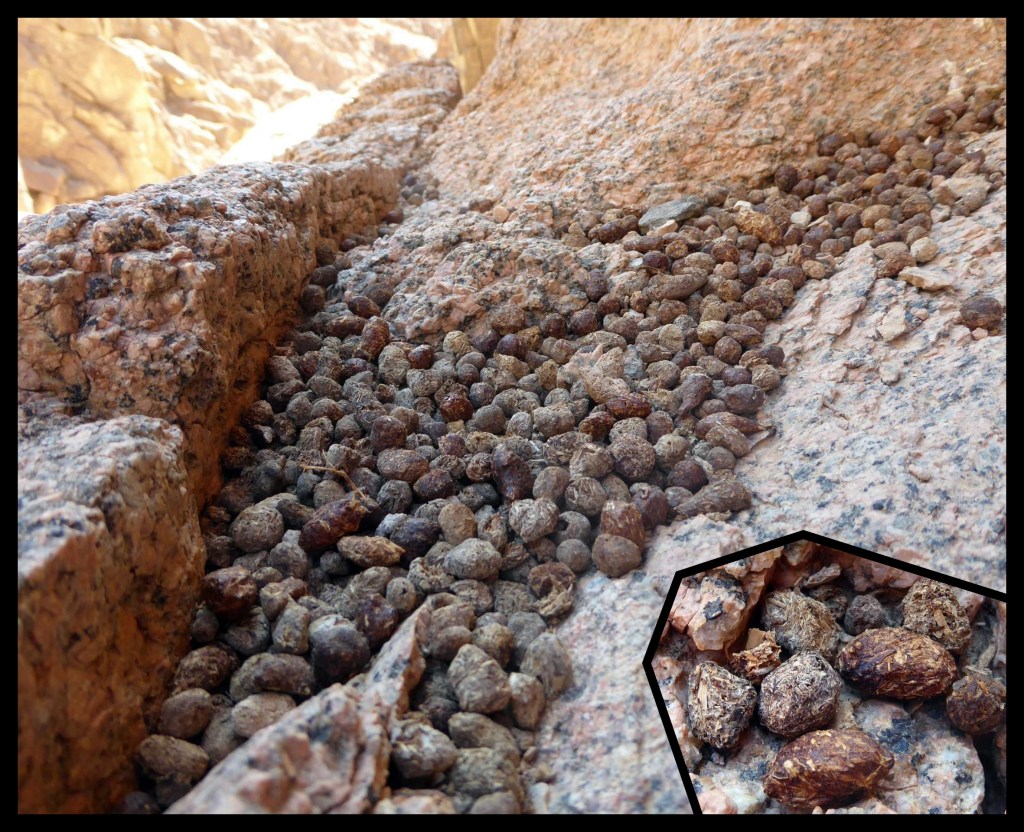
The subspecies of Rock Hyrax that lives in South Sinai is Procavia capensis syriaca. Sadly, it’s been reported that their population has been greatly reduced due to hunting and the clearance of acacia trees, their main food source, to make charcoal⁴. However, in the high mountain region of South Sinai, they are likely to consume other vegetation, like the leaves of wild fig trees, and the Jebeliya Bedouin attribute the decline in Rock Hyrax numbers to an increase in Red Fox (Vulpes vulpes), a predator. There have been no studies to confirm this though⁵.
Have you spotted a Rock Hyrax in South Sinai?
1 – Why these furry male mammals sing with humanlike rhythm. (2022, September 16). Animals. https://www.nationalgeographic.com/animals/article/why-these-furry-male-mammals-sing-with-human-like-rhythm
2 – Fuzzy Critters’ Crystallized Pee Changes Climate Record? (2026). Animals. https://www.nationalgeographic.com/animals/article/101015-urine-pee-rock-hyrax-climate-science-ancient-prehistoric
3 – Cutts, E. (2023, April). Stone Age Animal Urine Could Solve a Mystery about Technological Development. Scientific American. https://www.scientificamerican.com/article/stone-age-animal-urine-could-solve-a-mystery-about-technological-development/
4 – Hoath, R. (2003). A Field Guide to the Mammals of Egypt. Amer Univ in Cairo Press.
5 – Coals P, Gilbert F. Notes on hyrax in South Sinai’s highmountains. AFROTHERIAN CONSERVATION. 2015;(11):5-8.



 Wandering through Wadis