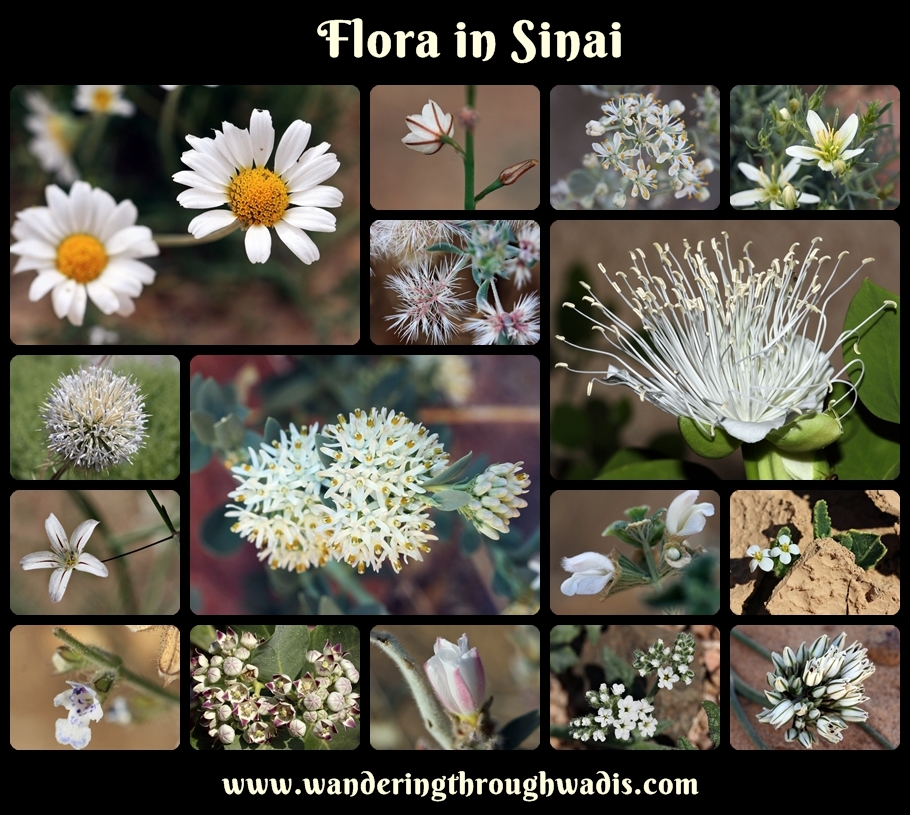
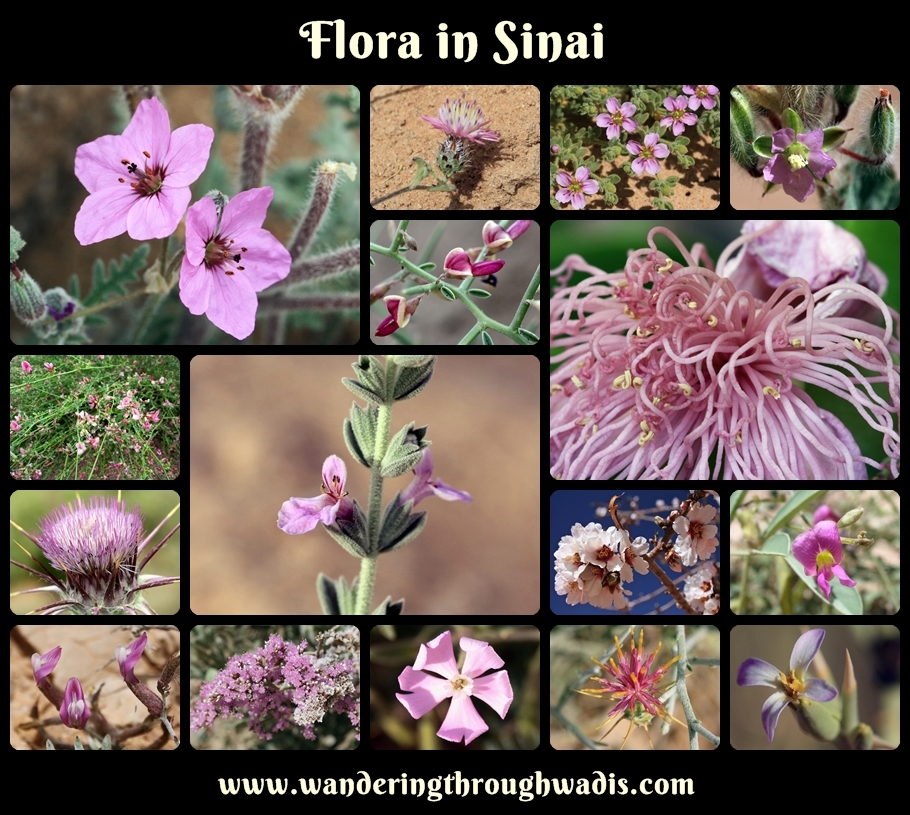
White is a common color for the desert flowers in South Sinai. In this collection, you can see the blooms of Wild Desert Onion, Chamomile, Asphodel, Horehound, Dead Sea Apple, Caper, Cometes, Globe Thistle, Heliotrope, Salt Tree, Wild Rue, Desert Baby’s Breath, Wild Mustard, Bindweed and Arghel.
You can find all of these blooms and more in my ebook. Check out the free excerpt!
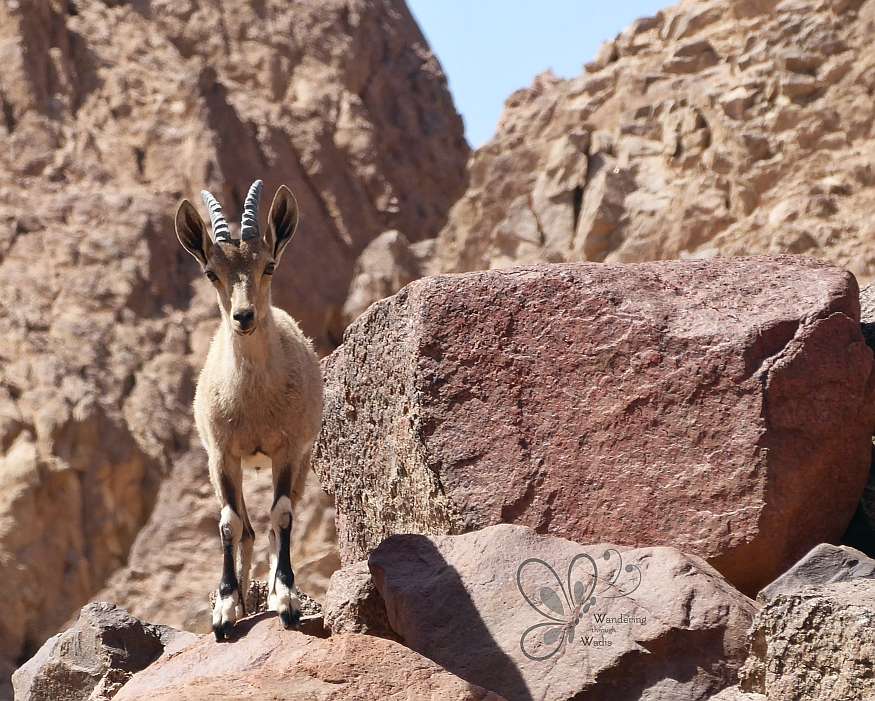
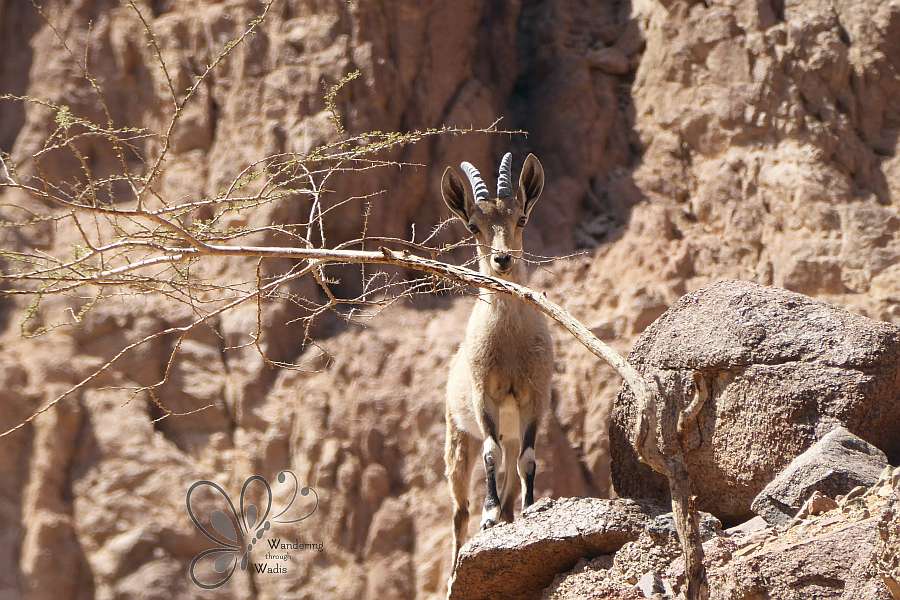
Last spring, while wandering through wadis, I was lucky enough to spot a Nubian Ibex. Many years ago while driving, I saw a small herd of ibex in the distance. We stopped the car to watch them, but they were too far away to truly appreciate. Not this time!
Nubian Ibex (Capra nubiana)
Nubian Ibex are strong and stout goat-like mammals, adept and agile at climbing through the rocky mountainous terrain they typically call home.
Both male and female Nubian Ibex have backswept, ridged horns that are “flattened like sword blades”, but they are longer and heavier in males. Their coat is a light sandy brown on their upper parts with a white belly and legs. Males, and some old females, have black beards. Nubian Ibex have a distinctive pattern on their legs, with black patches above and below the knee and a white patch above their hooves.
These animals are active in the early morning and late afternoon. Ibex are herbivores, eating grass, shrubs, roots, and Acacia, and they need access to standing water.
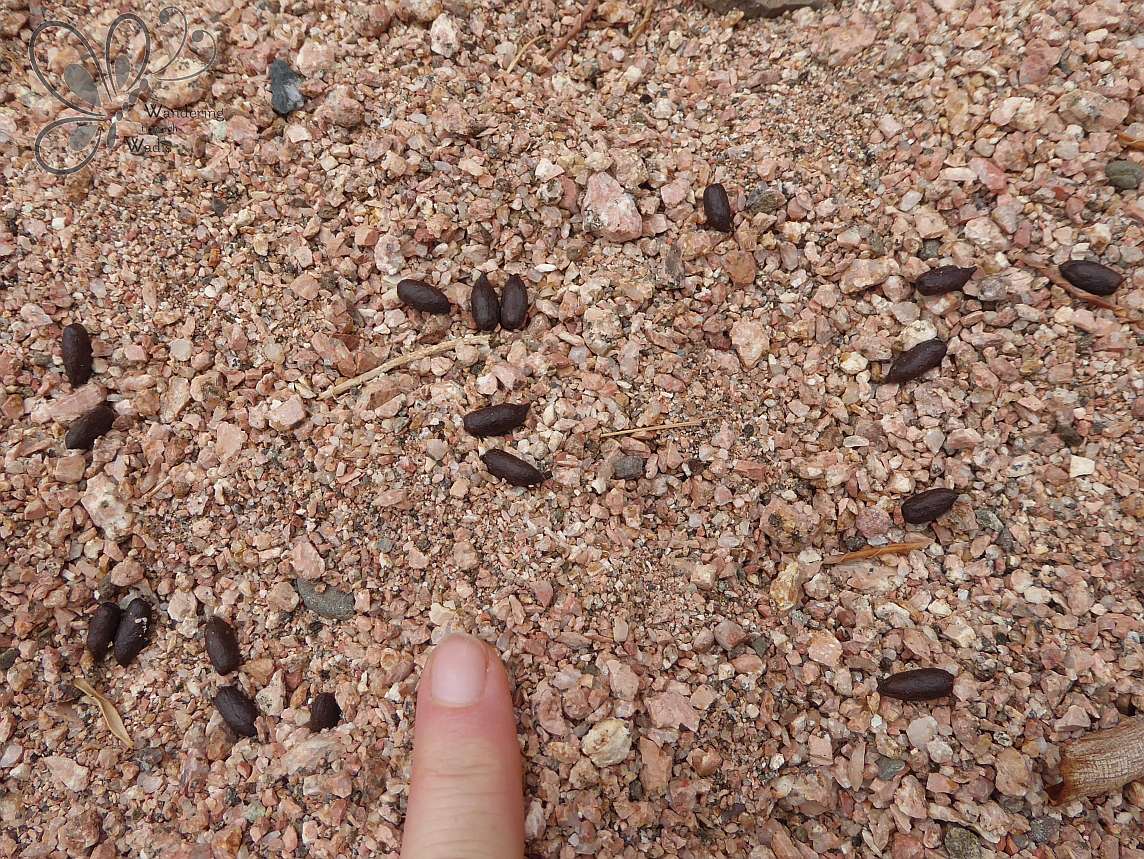
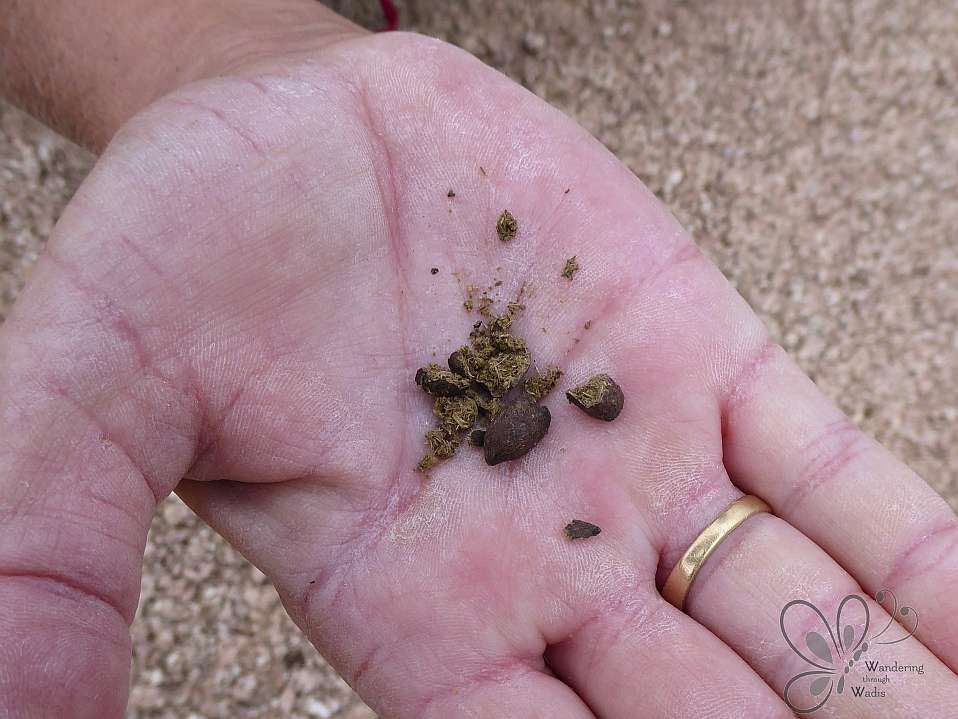
While I have not come across another more ibex, I have seen their scat in various places that I have wandered. The scat is pellet-shaped and consists only of vegetation (not fur or feathers as in carnivores).
Encounters with ibex in South Sinai are rare as the number of these beautiful mammals has been greatly declining over the years, due in part to illegal hunting (which is why I won’t say where exactly I was wandering when I spotted this one). They are listed as a “vulnerable” species on the IUCN Red List. Their survival is also threatened by competition with local livestock and feral camels, habitat loss and degradation, and the fluctuating availability and distribution of waterholes.
My encounter with a Nubian Ibex was indeed special and not one I shall ever forget!
References:
Hoath, Richard. (2003). A Field Guide to the Mammals of Egypt. Cairo: The American University in Cairo Press.
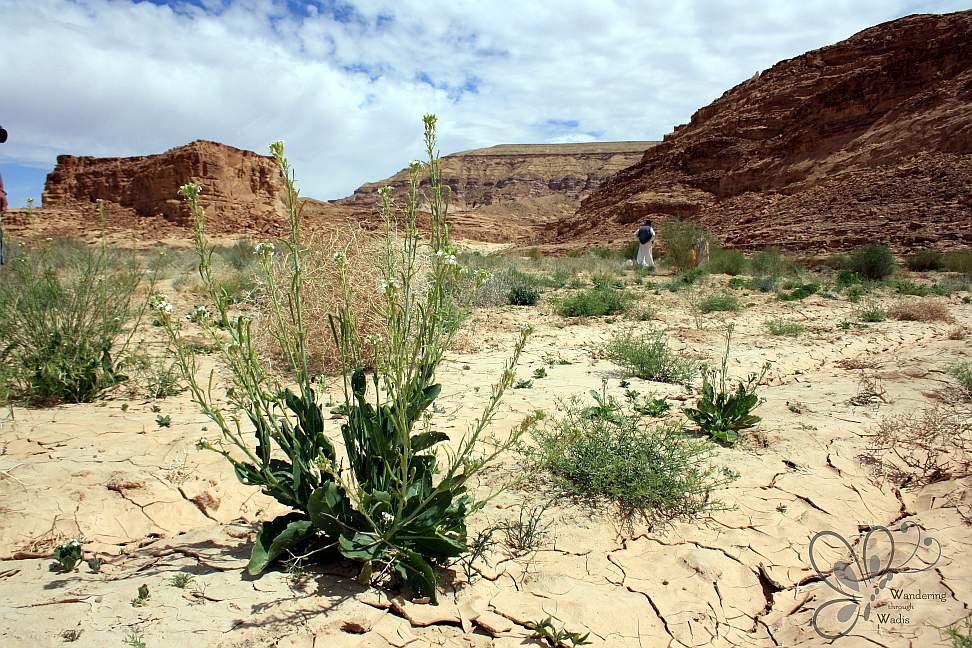
During the recent Christmas holidays, I spent a day with my family on a desert safari near Wadi Arada. This area has already been blessed by winter rains, so I was thrilled to see some of my favorite plants already sprouting – and in bloom!
This is a type of wall-rocket (Diplotaxi acris), a wild mustard in the cabbage family, called jahag or yahag by the Bedouin. It is one of the species that appears shortly after seasonal rains in desert plains.
It is an annual plant with alternate, serrated-edged leaves that grow out from the base in a rosette formation. The leaves are juicy and peppery-flavored and make a tasty addition to a fresh salad. Of course, the goats, sheep, and camels like to graze these greens as well.
The four-petaled flowers, also edible, are white to pinkish-purplish in color. There is a related species in Sinai, Diplotaxi harra, that has yellow flowers.
Have you ever seen jahag on your desert adventures? Have you ever tasted it?
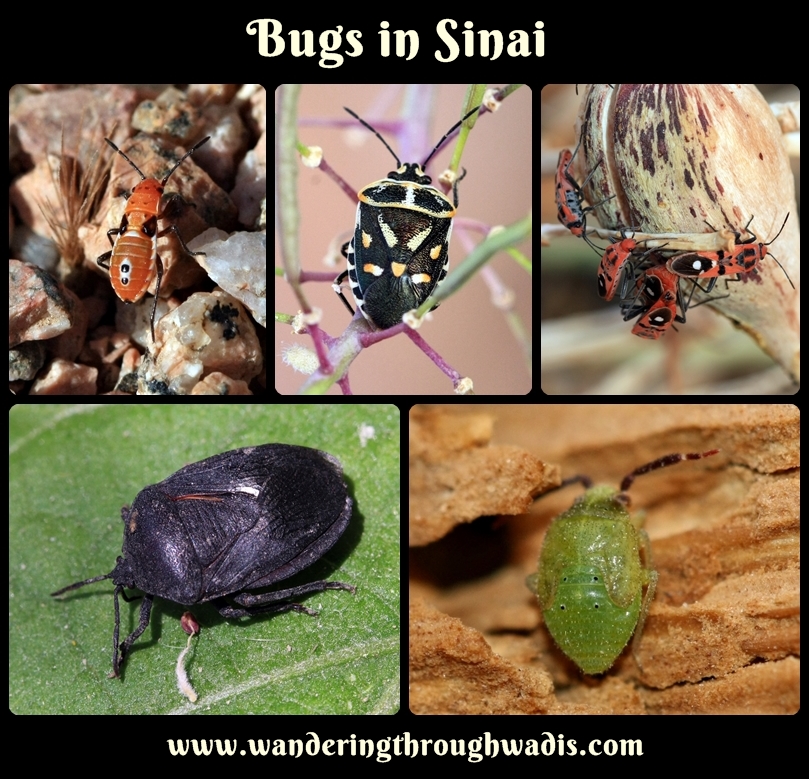
Not all insects are bugs. True bugs form the order Hemiptera and include such critters as cicadas, aphids, planthoppers, leafhoppers, and shield bugs. Most bugs feed on plants, using their sucking mouth parts to get at the sap.
Here you can see a nymph of a Lygaeid bug, a Bagrada Bug, Milkweed Bugs, a Black Watermelon Bug, and a Shield Bug nymph.
This collection includes one of my absolute favorite blooms – those on a caper bush! While they start off completely white, their color changes to pink and then a dark purple. Read about capers in this previous post.
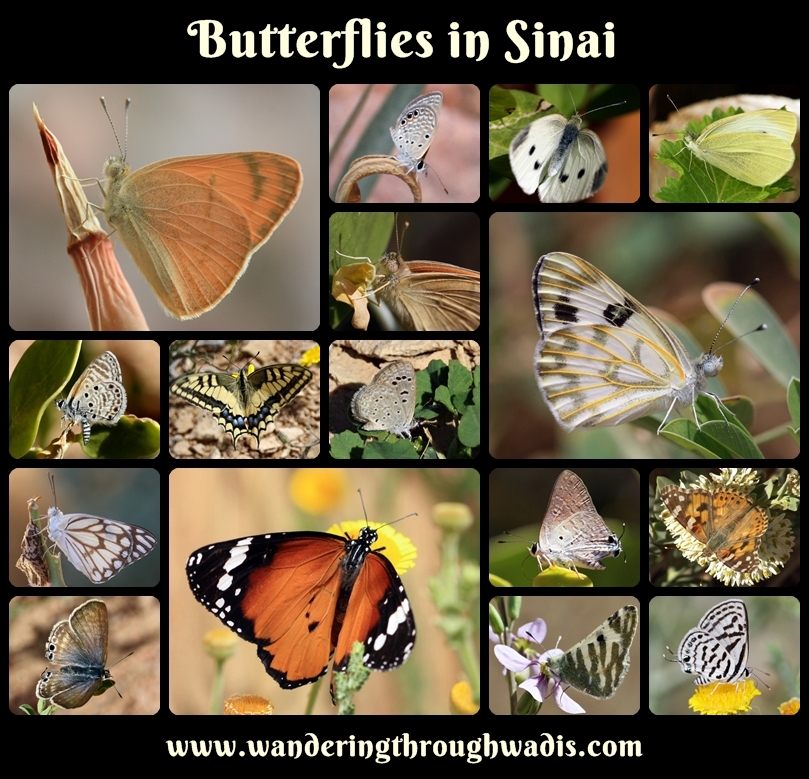
Butterflies! I love them. I am enthralled by their process of metamorphosis. Over the years, I have raised dozens of them indoors and watched them grow and change from tiny caterpillars to delicate chrysalises to beautiful butterflies. Often I share this experience with my students, who are as fascinated as I am, learning along with them.
I am able to identify most of the butterflies I spot thanks to the book Butterflies of Egypt: Atlas, Red Data listing & Conservation by Francis Gilbert and Samy Zalat. You can download the book for free here. Many thanks to the authors for sharing this amazing resource!
In the photo collection above, you can see:
Large Salmon Arab (Colotis fausta) Grass Jewel (Chilades trochylus) Small White (Pieris rapae) African Babul Blue (Azanus jesous) Saharan Swallowtail (Papilio saharae) Dark Grass Blue (Zizeeria karsandra) Desert White (Pontia glauconome) African Caper White (Belenois aurota) African Monarch (Danaus chrysippus) Pomegranate Playboy (Deudorix livia) Painted Lady (Vanessa cardui) Long-tailed Blue (Lampides boeticus) Scarce Green-striped White (Euchloe falloui) Mediterranean Tiger Blue (Tarucus rosaceus)
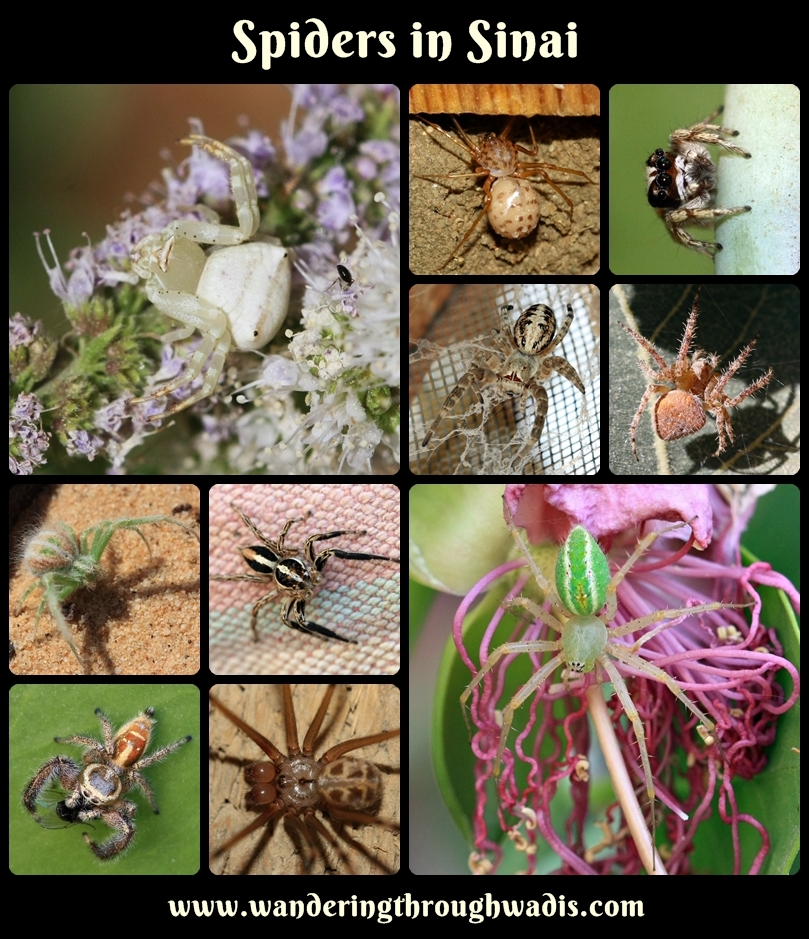
It wasn’t until I turned my camera lens from the desert blooms to the creepy crawlies that I got over my fear of spiders. Mostly. Big, hairy ones still freak me out. But the little ones I find around the local wadis and my own desert garden have grown on me and I think they are quite stunning! Luckily, none of these commonly seen spiders are venomous, but there are dangerous spiders in Sinai, like the rare White Widow Spider. Camel Spiders are not spiders nor scorpions, but rather in their own order of Arachnids.










 Wandering through Wadis