Amicta Bagworm Moth

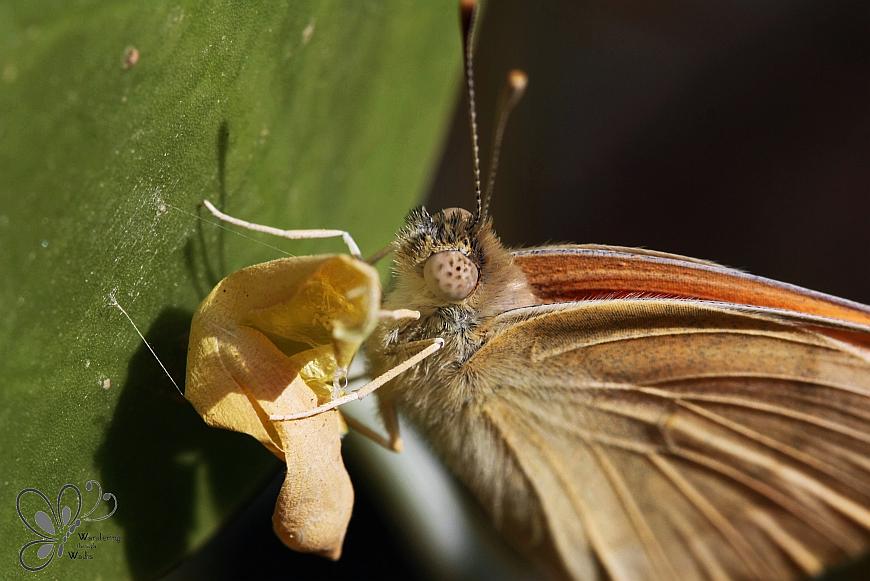
One of the most fascinating things that I have come across while wandering through wadis is the case of the Amicta Bagworm Moth (Amicta quadrangularis).

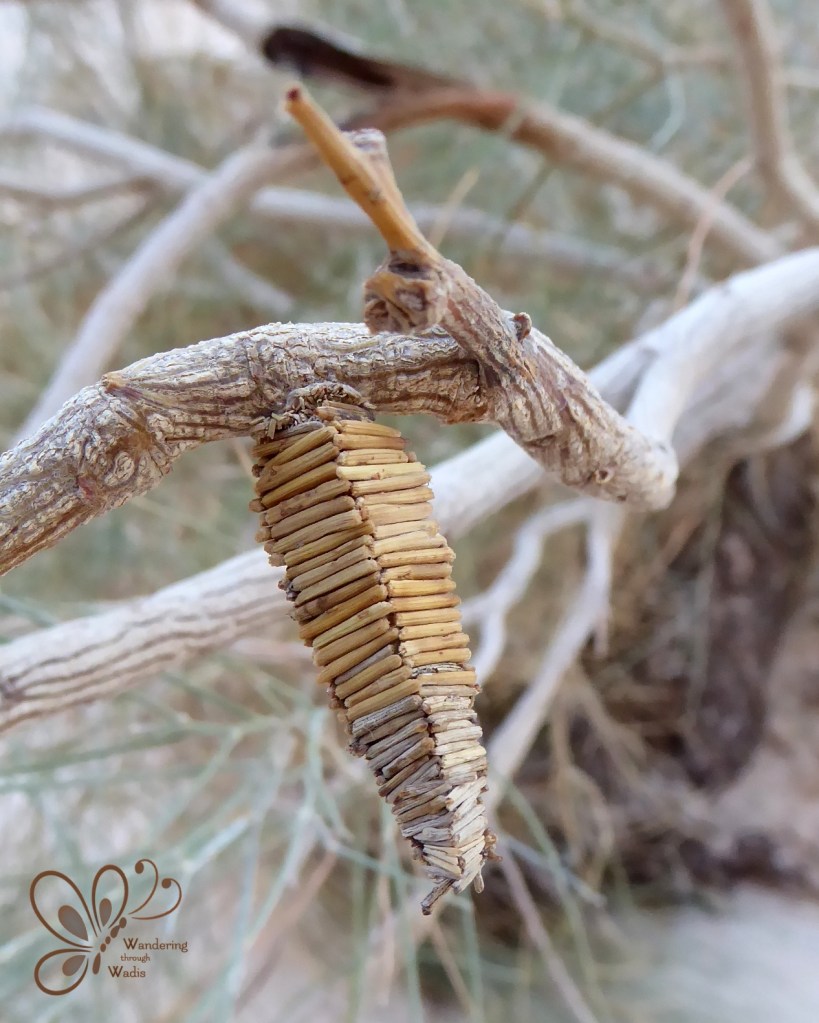
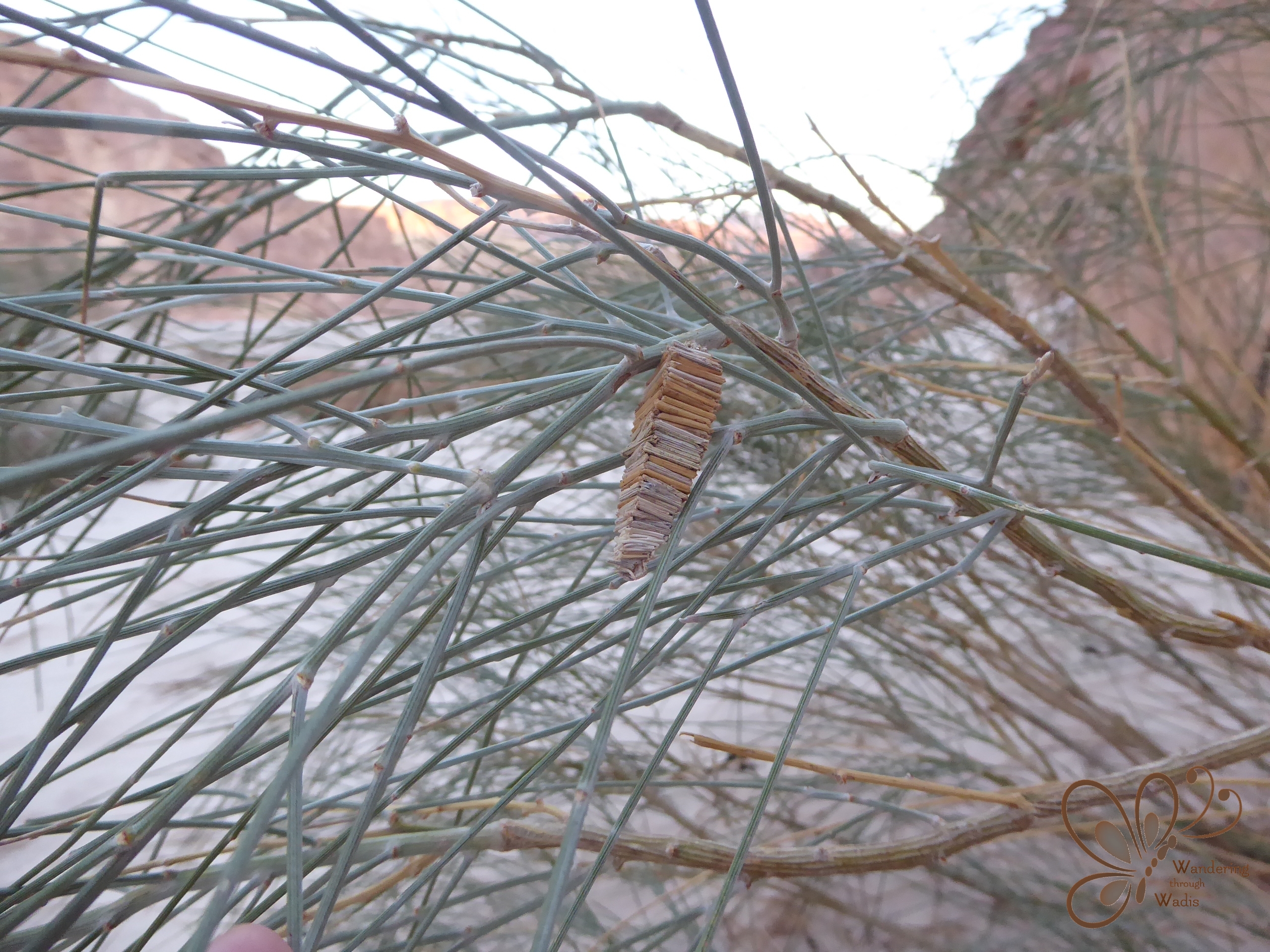
The first time I spotted one, there were several hanging on stems of a White Broom bush, called ratam in Arabic, in Wadi Arada. I had absolutely no idea what I was looking at. I was simply amazed by the precision of the architecture! Thanks to members of Project Noah and my own further research, I was able to identify the creature behind this masterpiece – an Amicta Bagworm Moth.

Wadi Arada_Bagworm Moth Case (2)

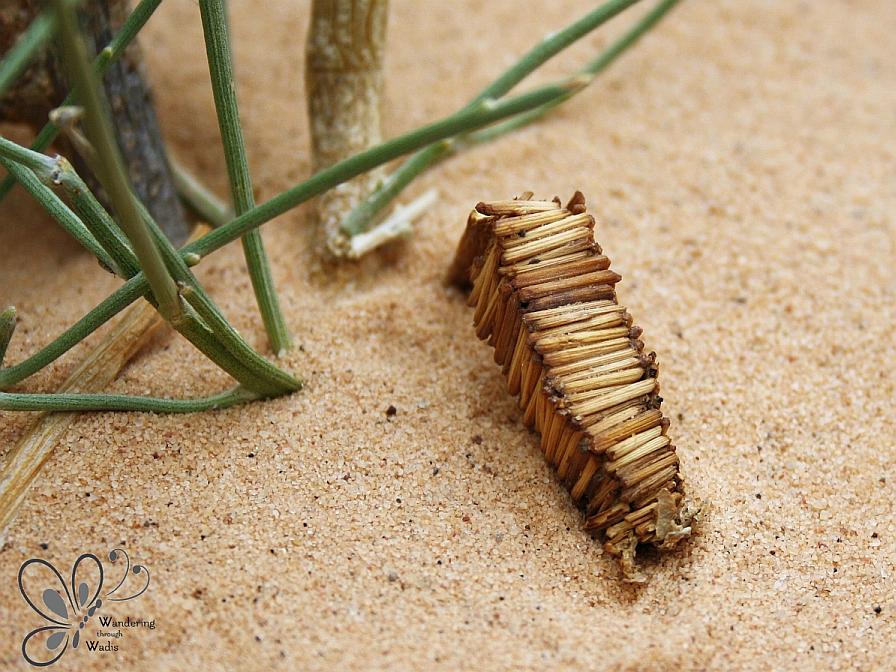
Bagworm moths, a name given to those in the Psychidae family, go through a 4-stage metamorphosis typical of moths, from egg to larva (caterpillar) to pupa (cocoon) to adult. As soon as the egg of a bagworm moth hatches, however, the larva begins to build a protective case to hide in. The “bag” or case is constructed out of silk and items found in the environment. In the case of the Amicta Bagworm, that’s the thin branches of its host plant, White Broom (Retama raetam), giving it some camouflage as added protection. And what do they need protection from? Mostly birds and parasitic flies and wasps.

P1120130

These caterpillars go through five larval stages and, as it grows, the caterpillar continues to add longer material to the four sides at the front of the case. The hungry caterpillar extends its head and thorax through the opening at the front in order to eat leaves. There is an opening at the back through which it excretes waste. And the caterpillar moves around, carrying its case behind it on its abdomen.

When the caterpillar is ready to pupate, it attaches the case to a branch of the ratam bush. As adults, the female Amicta moth does not have wings and she does not leave the case. The male moths will come to her. She lays her eggs, as many as 1500, in her case and then dies. Female sacs are larger than the male ones.

Each type of bagworm moth creates a unique case, specific to its own species. The cases, therefore, are often very useful when trying to identify these moths. I have never seen, as far as I know, the caterpillars or the moths of the Amicta Bagworm, but I love the design of their homes! Have you ever spotted these fascinating creations in the wadis?

References:

Bagworm moth – Wikipedia

Husseini, M. & Askar, S. (2019). The bagworm, Amicta quadrangularis (Christoph), and its natural enemies in Northern Egypt (Lepidoptera: Psychidae). Egyptian Journal of Biological Pest Control, 29:30. https://doi.org/10.1186/s41938-019-0127-7 

[UPDATED: December 25, 2023 with new photographs and additional information.]


Caper Bush ~ Part II

In Part I in my series on caper bushes, we learned what these plants look like, where to find them, how they grow, and why they make good additions to desert gardens. Today, I’ll share how to prepare the plant so you can savor their unique flavor.

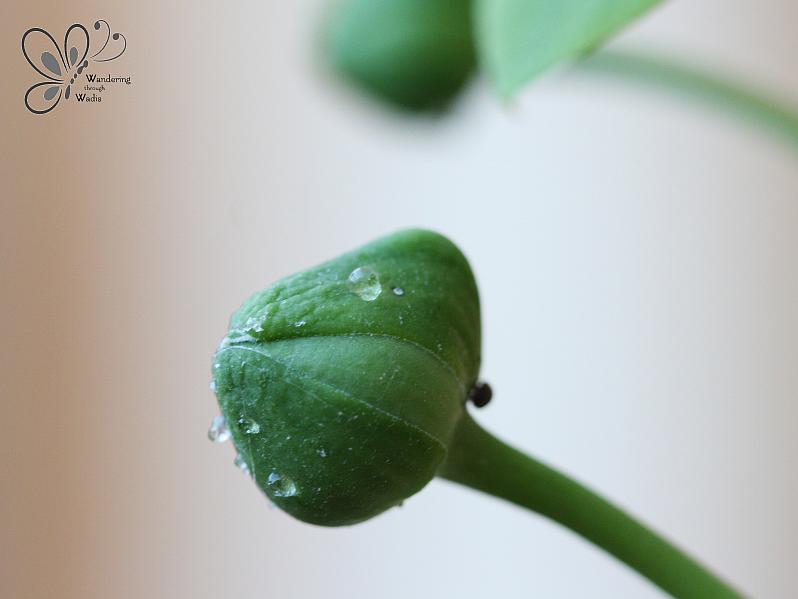
You may already be familiar with capers, as they are a common ingredient used in Mediterranean cuisine and are available commercially in many places around the world. These are the flower buds of caper bushes, specifically Capparis spinosa. (Although C. sinaica, which also grows here in Sinai can be used, as well.)

IMG_0639

The buds are picked when small and then salted and/or pickled. They are used in salads, pastas, meat dishes, sauces, and are popular in salmon and other fish dishes.

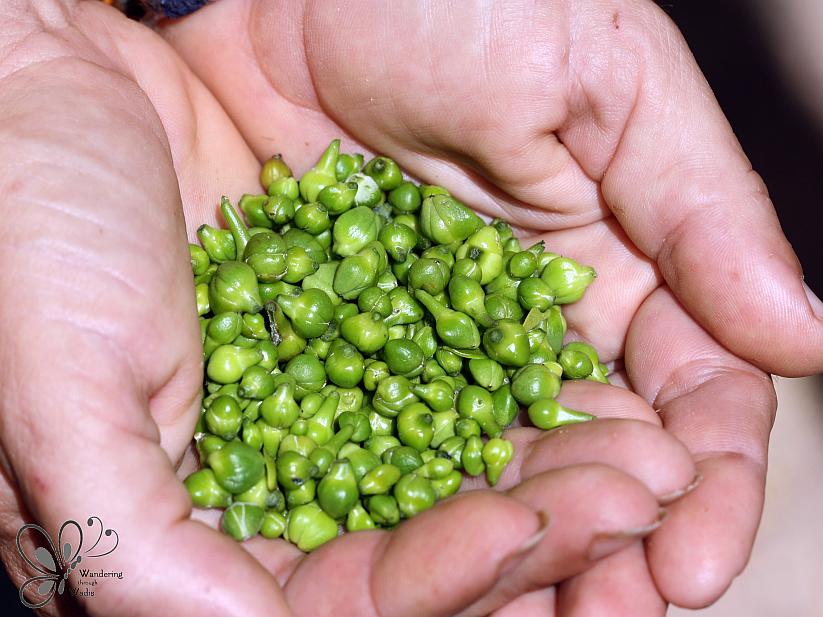
Before the caper bush in my garden was big enough to supply enough flower buds for pickling – and even now as I prefer to leave our buds to grow into flowers and fruit – we would forage for the buds as we wandered through wadis. At the right time and place, it doesn’t take long to collect a handful of flower buds. We pick a variety of sizes, but try to keep them on the smaller side.

IMG_6429
Caper flower buds foraged from a wadi near Dahab.

Once you’ve collected the flower buds, put them in a jar, fill with water, and cover with a cloth. Let the buds soak for 3 – 7 days, changing the water every day (or every other day). The buds will turn from a bright green color to a more olive color. They will also start to give off a strong smell and white crystals or film may appear. This is all normal. The buds are releasing their mustard oil and their not-so-nice flavor.

At the end of the week, the capers should be giving off less of an odor and are ready to be pickled. You can use a vinegar brine or, even simpler, a lacto-fermentation method which just involves salt water. That’s what I do. I mix 220 mL of water with 1 tablespoon of salt. (Or multiples of that when I need more water.) Put the caper buds in a clean, sterile jar and pour the salt water over them, making sure they are all covered. Leave them for 3-4 days and then put them in your fridge; they will last a long time.

IMG_6525
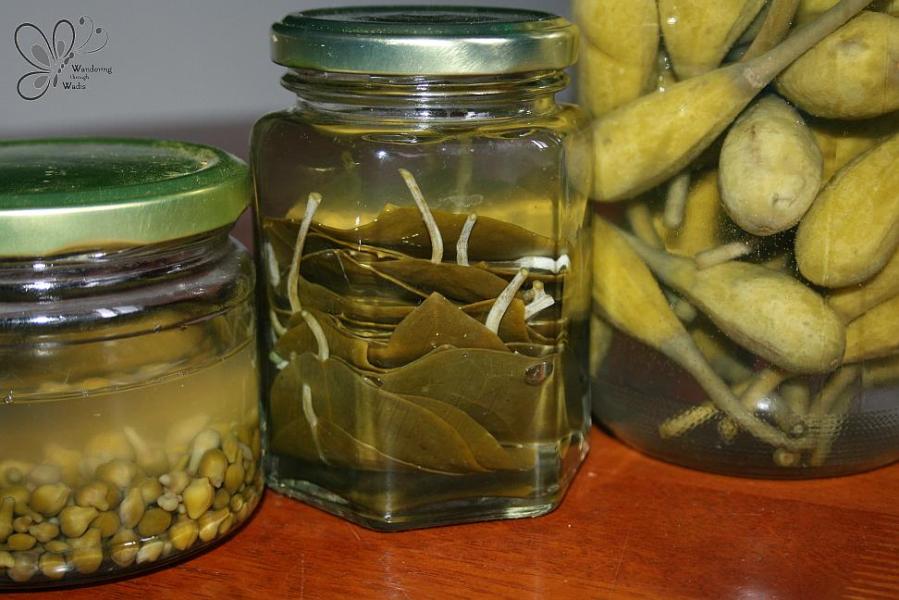
Pickled flower buds – and one fruit – ready to be eaten.

Pickled flower buds are not part of the Bedouin culinary tradition, but pickled fruits are! Forage for fruit on the bushes in the wadi or collect them from your garden. You want to pick them when they are still green, not yet ripe. I generally pick them when they are between 5 – 8 cm long.

IMG_6499
The first harvest of the season from my garden caper bush.

You can follow the same method for pickling as described above for the flower buds. The fruits definitely need 7 days in water before they are pickled and give off a much stronger odor than the buds. The pickled fruit are called caper berries in English.

IMG_6505
Fruits need to soak for 7 days before pickling.

This is my first year to do so, but you can also pickle the leaves of the caper bush following the same procedure.

IMG_6510
Pickled flower buds, leaves, and fruit.

Bedouin friends have recommended cutting shallow slashes into the fruit before they are pickled. This allows more of their flavor to be released into the water. Bedouin will then use a few spoons of this zesty liquid to spice up their lentil and rice meals.

We like to eat the pickled caper fruits smashed up in white cheese, which we then scoop up with local flat bread. Delicious! I am looking forward to experimenting with the pickled caper leaves – as a side salad, with deviled eggs, with cheese, with fish. And the flower buds we use in typical Mediterranean fashion, usually on pastas and pizzas.

The caper fruit can also be eaten fresh, when it is red and fully ripe. As I mentioned in my first post about capers, you have to beat the ants to it! Pick the red fruit just as it’s ready to split. If you catch them before they split, open the fruit and use your teeth to scrape the flesh and seeds off of the hard skin. Whether or not to chew the mustard-flavored seeds is up to you. The Bedouin children, who have eaten plenty of fruit from my garden, warn me never to chew the seeds, as they will give you diarrhea. But I’ve heard from other people who chew the seeds and do not suffer from any intestinal upset. I’ve tried the fruit fresh but did not chew the seeds. They taste okay, but I prefer them pickled!

Besides being beautiful and delicious, caper plants are also used medicinally by the Bedouin. (Amazing plant, right?)  A poultice made from the crushed leaves is used to treat rheumatism, joint aches, headaches, and toothaches. Inhaling the vapor made when boiling ground dried leaves is said to treat head colds. I have used a poultice to treat joint aches and I can testify that the crushed leaves really do heat up, much better than creams from the pharmacy.

Okay, enough.

Have I convinced you to grow a caper bush in your garden yet? 😉

Green Lynx Spider

And another critter who occasionally calls my caper bush home – the Green Lynx Spider (Peucetia arabica)!

IMG_9054

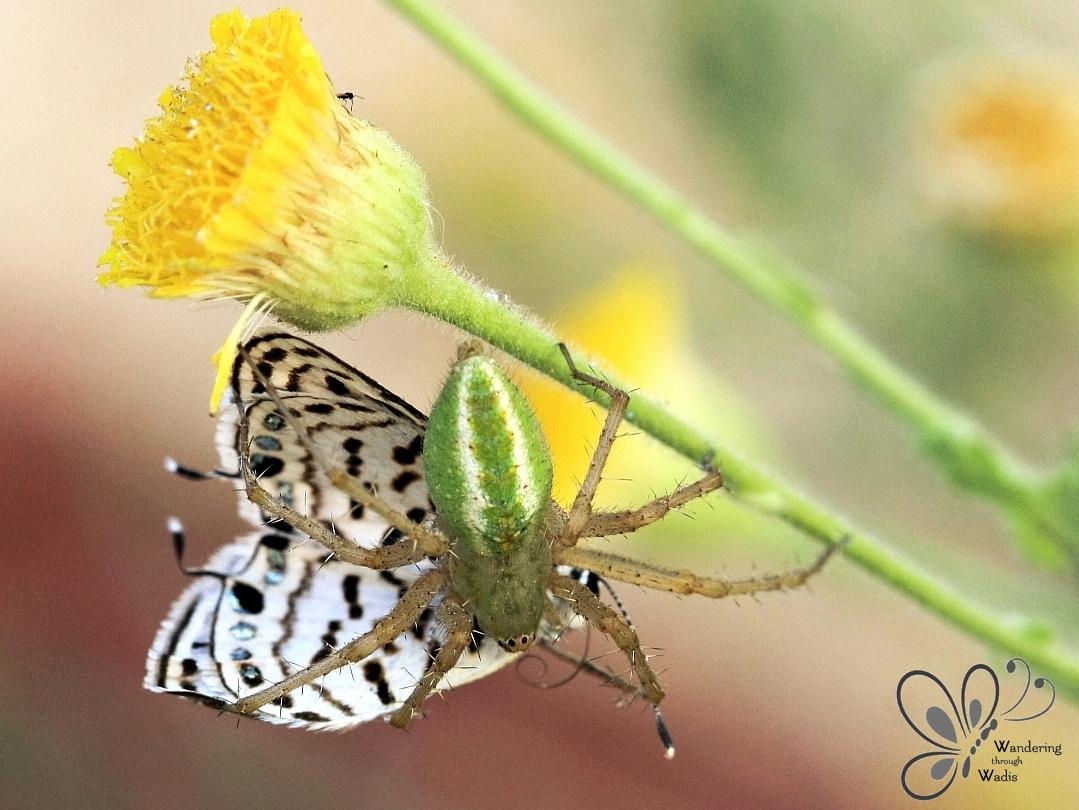
These spiders are bright green, often with white and red markings on the body. The legs are covered in large bristles, which most likely helps them catch and keep hold of their prey. They have keen eyesight and a unique arrangements of their 8 eyes: six of them are arranged in a hexagonal pattern and two smaller eyes are below and in front of these.

IMG_1493

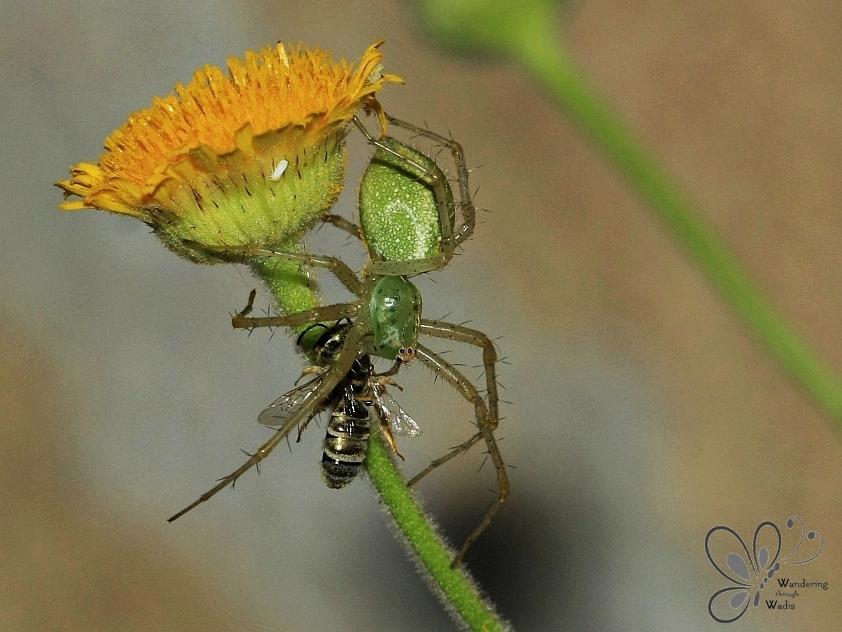
They are ambush hunters and do not use webs. Instead, they live on the plants and wait, hidden by their camouflage, for their prey and then attack.

Pepper Spider (2)

Green Lynx Spiders eat a variety of insects – flies, bees, wasps, and butterflies.

IMG_1762

IMG_3312

Wadi Paradise_Feb14 (12)

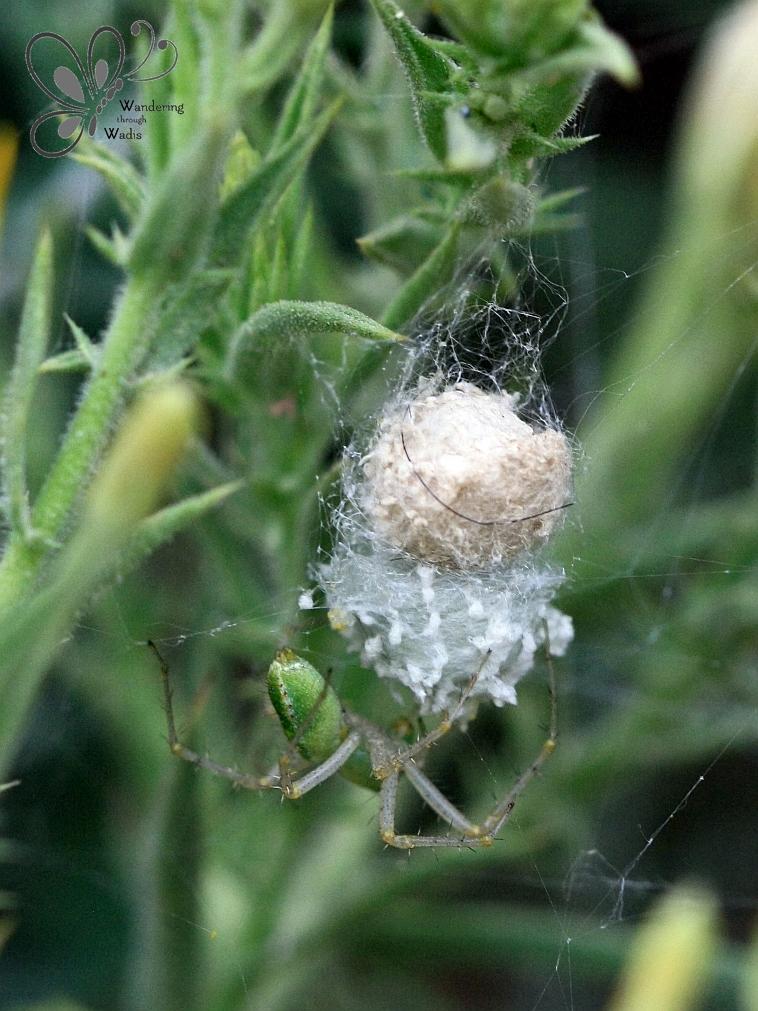
As you can see, they often eat pollinators, so I was not always happy to have these spiders in my garden, where they were content to live on a number of the local plants, as well as my pepper and basil plants. If you look closely as you wander through the wadis, you might spot them on Iphiona plants or Cleome herbs (samwa). Often, it will be the spider’s prey that you spot first. Or an egg sac.

garden lynx with eggs

Each of their egg sacs can contain hundreds of eggs that hatch into cute little spiderlings.

Green Lynx Spiderlings_garden (1)

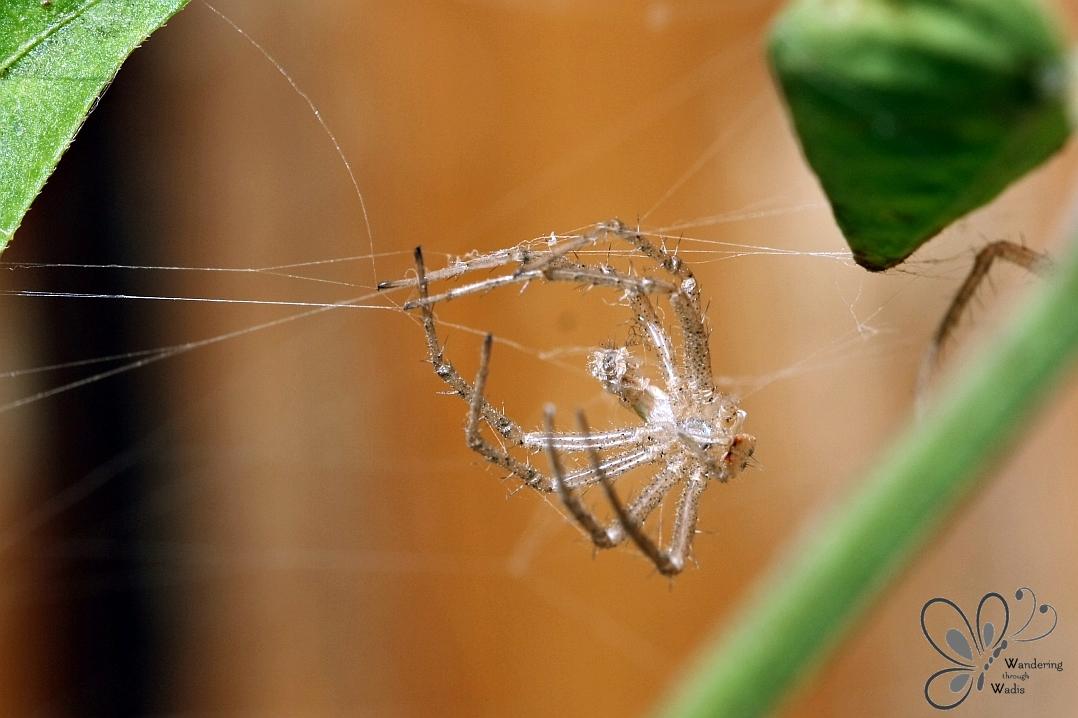
Like all spiders, the Green Lynx has an exoskeleton that, although flexible, does not grow. As the spiders get bigger, they must grow a new exoskeleton and shed, or molt, the old one. The old skin gets left behind, like the one shown below.

IMG_7287

There is not a lot of information about this species of spider available on the Internet, at least not in English. So, I couldn’t find out more about this last photo – a female Green Lynx Spider apparently eating her mate!

IMG_7326

Have you spotted this spider on your wadi wanderings?

Large Salmon Arab Butterfly

Of the nearly 19,000 butterfly species in the world, only 63 occur in Egypt. And this beauty – a Large Salmon Arab (Colotis fausta) – has been fluttering about my garden lately!

IMG_3569

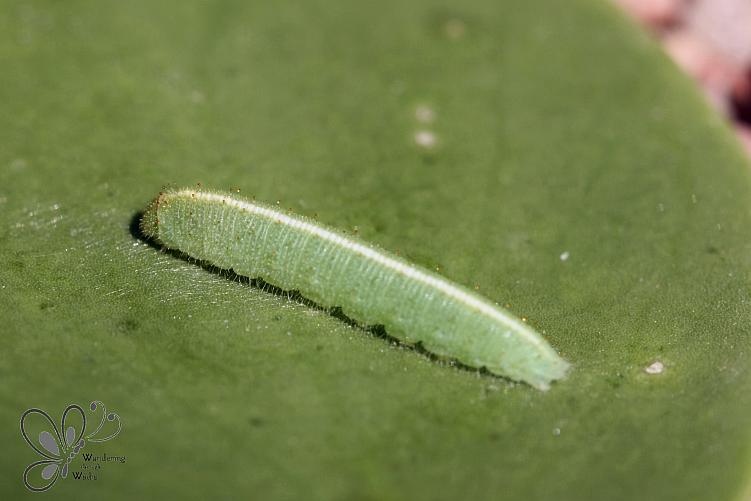
We are lucky here in South Sinai, as the mountainous region is one of the hotspots of butterfly diversity in Egypt, home to 2/3 of the butterflies found in Egypt. The Salmon Arab is a member of the Pieridae family of butterflies, or Whites, as they are commonly called. Like most butterflies, they go through a 4-stage metamorphosis: egg, larva (caterpillar), pupa (chrysalis), and adult. The eggs are laid on and the caterpillar feed on the leaves of caper bushes (Capparis sp.), which is why I find these butterflies in my garden and where you’ll usually spot them in the wadis. The caterpillars are light green, hairy, and have a pale-colored stripe through their body.

Large Salmon Arab Catepillar (1)

The larva continue to eat, grow, and molt (shed their skins) until they are ready to form their chrysalis (a hard skin) and start to pupate. The chrysalis is attached, usually to a leaf, by silk threads.

IMG_1839

After about a week, the adult butterfly emerges.

IMG_1888

The upperside of the wings are a salmon-pink to an orange-yellow color and the forewings have dark scales and black spots along the edges. In the dry season, they are smaller and lighter-colored. You can find these butterflies in flight between April and November.

Large Salmon Arab Butterfly_Garden Caper (2)

As a curious nature-lover as well as a teacher, I will occasionally raise caterpillars indoors to learn more about them. Check out the proboscis (sucking mouth part) on the newly-emerged butterfly below!

IMG_0307

Although the weather is getting a bit too hot to be wandering through wadis these days, you might just spot these butterflies near the caper bushes around town!

References:

Butterflies of Egypt: Atlas, Red Data Listing, & Conservation

Francis Gilbert & Samy Zalat

PDF version of the book is FREE to download here.

Caper Bush ~ Part I

Caper bushes (Capparis spp.) are some of the most common plants that you will come across when wandering through the wadis of South Sinai. They are also one of my favorites and one of my most photographed. So, I have a lot to say about them and too many photos. You’ve been forewarned. 😉

Arada-Zaranik-el Akhdar_May2010_45

There are three species of capers growing in Sinai: Capparis decidua, C. sinaica, and two different subspecies of C. spinosa. C. decidua, which I have never seen, is easily distinguished from the other Capparis species. It grows as a small tree and the others are bushes. In English, we call them all capers, but the Bedouin differentiate between  them. In Arabic, C. spinosa is called lasoof and C.sinaica is called lasaf.

DSCN8057

Caper bushes are shrubs growing between 1 and 2.5 meters high. They usually grow prostrate along the ground, scrambling over rocks, or hanging in cliffs. Capers can tolerate saline soil and drought. And they love dry heat and direct sunlight! (This makes them excellent additions to desert gardens. More on that later.)

Ain Yarqa (7)
Capparis spinosa – Ain Yarqa

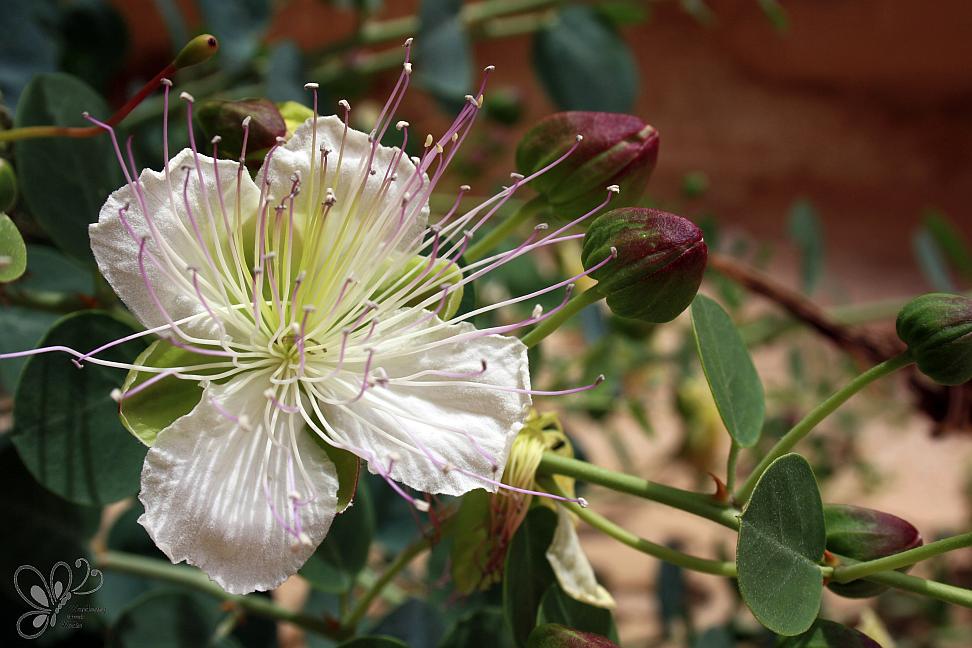
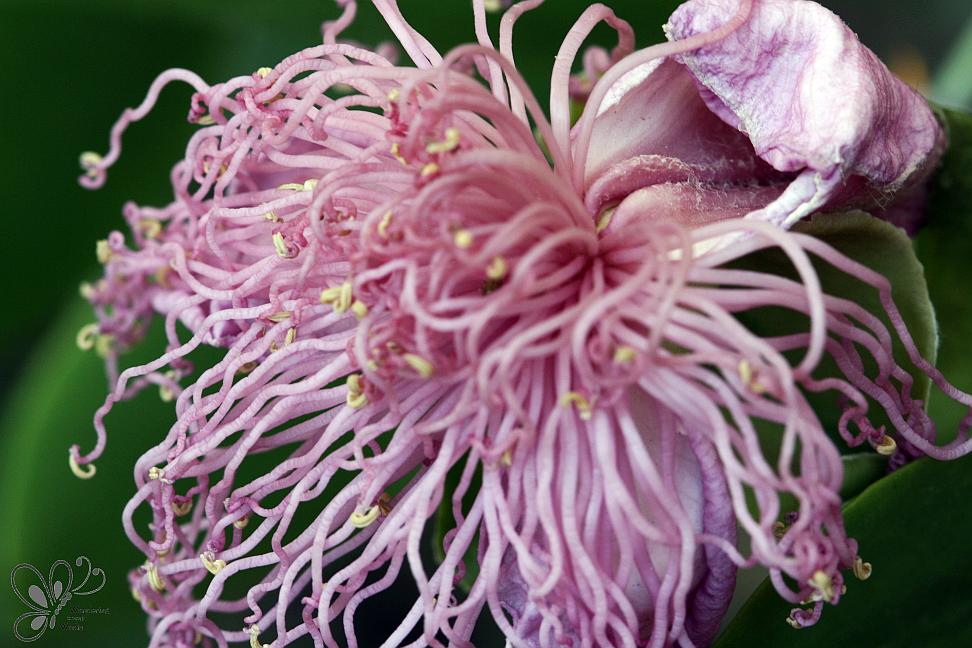
The branches are smooth and hairless and grow out from the base of the plant. The leaves  are thick and fleshy and those of C. spinosa are round or oval while the leaves of C. sinaica are shaped more like an egg, getting narrower near the tip. The flowers – oh, the flowers! – are white with lots of stamen. In C. sinaica, these stamens are initially white but turn purple as they begin to wilt. In C. spinosa, they are white and pinkish-purple from the start and turn a darker purple. Both blooms are simply stunning!

Arada-Zaranik-el Akhdar_May2010_79
Capparis spinosa

Flower buds grow only on first-year branches, bloom at night, and live only for 24 hours. It is amazing to watch the blooms open, and since I have a caper bush in my own garden, I’ve had plenty of opportunities to do so.

caper-tile

I am seriously in love with these flowers and how their color changes throughout the day!

IMG_6367

IMG_0469

captive capers 2011_04

IMG_0855

The fruits of these caper bushes are pretty amazing as well. They are somewhat pear-shaped; the young fruit are green, turning a brilliant red when ripe, and contain hundreds of small seeds. And they’re edible! (More on that later, too.)

Wadi Jiddy_Oct2010_31

Caper bushes often have buds, flowers, and fruit at the same time. They start blooming in May and will continue to do so until late summer. When you come across these bushes in the wadis, you’ll often find the ants or other critters have already munched the seeds of the burst fruit.

near Wadi G'Nai_20

But if you have a caper bush in your own garden, you can beat the ants to the feast!

Ripe Caper Fruit (1)

When we bought our land in Dahab nine years ago, we built our house and had an empty desert plot in front, a blank canvas, our garden. We planned on growing only local desert plants, and, for the most part, our little garden is made up of the same bushes and herbs you find growing in the desert wadis of South Sinai. Our plan definitely included a caper bush. I wanted one right underneath the front window.

Irena Springuel recommends capers in her book The Desert Garden: A Practical Guide because of their beautiful blooms and edible parts. She does warn, however, of the thorns and recommends keeping that in mind when choosing a planting site. You wouldn’t want visitors or children getting hurt by the spines. (And they do catch you! My husband and I have both been hooked on numerous occasions and it hurts.)

The notes that Springuel gives about propagating capers (C. spinosa) made me think it would be a challenge to grow a caper bush from seed. But I collected a ripe fruit from a bush (C. sinaica) in a nearby wadi and simply planted the seeds in a clay pot at home. Several sprouts grew and they continue to thrive in my garden today. We have a beautiful large bush now, exactly where I dreamed of having one, and it is producing loads of fruit. You can also propagate capers by cuttings, which we have done successfully, too.

If you’re looking for a beautiful, low-maintenance plant for your garden, try a caper bush! Many of the bushes around Dahab are fruiting right now, so it’s the perfect time to see them and collect seeds. In my next post, Caper Bush ~ Part II, I’ll tell you all about which parts of the plant you can eat, how to process and prepare them, and how the Bedouin use capers medicinally.

References:

Springuel, Irina. (2006). The Desert Garden: A Practical Guide. Cairo: The American University in Cairo Press.

And my book, too.

Shrikes

Southern Grey Shrike_Lanius meridionalis (1)

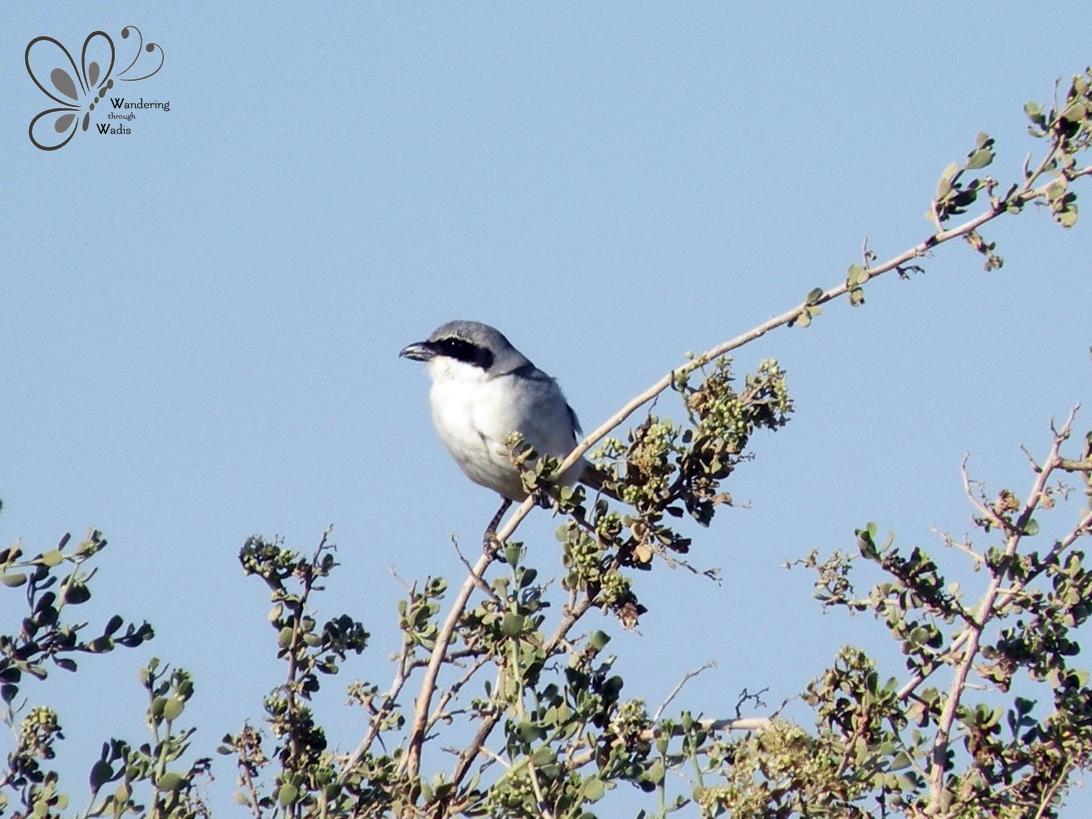
Southern Grey Shrike (Lanius meridionalis) near Ras Sudr

Great Grey Shrike

Black patch over beady eye,

Fearsome pirate perched up high,

Marauder at your lookout post,

Smaller birds fear you the most.

You squeak and chatter, call and trill

And imitate with cunning skill.

You wait, your victim to impale,

Just like the Vlad of fairy tale,

Then stab each one on thorny spike,

Cruel and vicious, Great Grey Shrike.

(Poem by Julia Johnson)

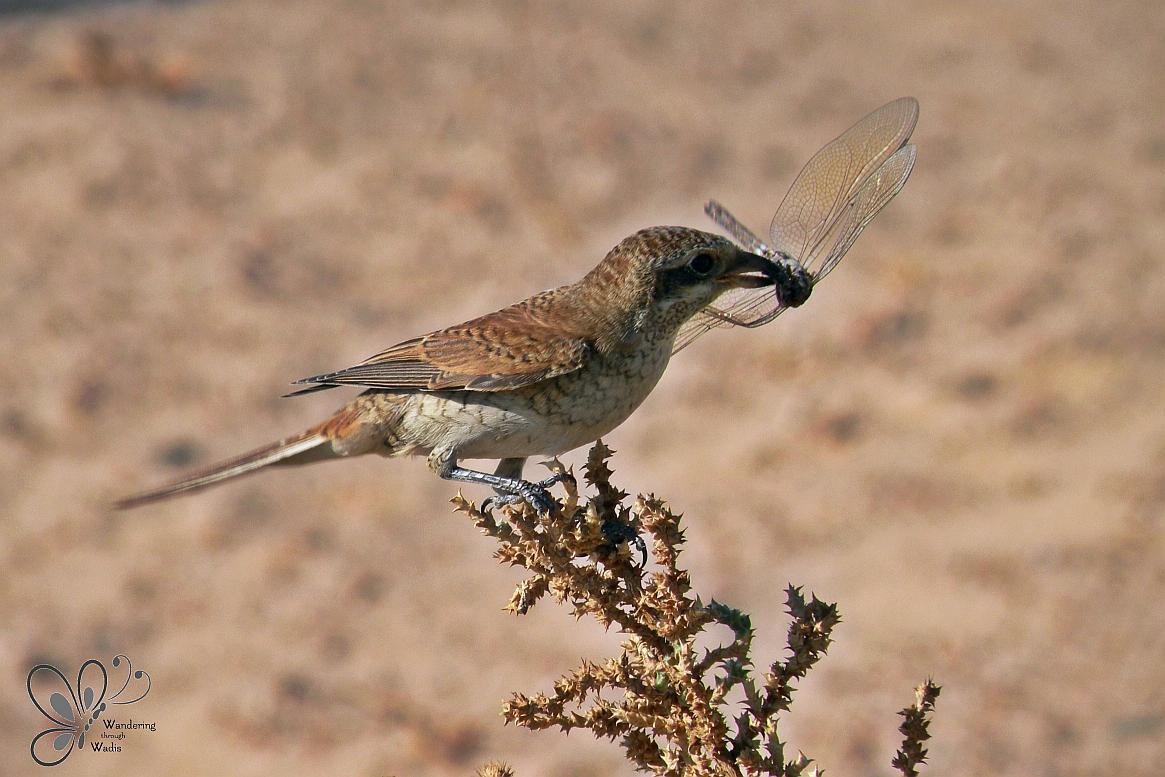
Six species of shrikes occur in Egypt, including the Great Grey Shrike, and I’ve spotted three of them in South Sinai. Like all shrikes (Lanius sp.), they feed on insects, lizards, small rodents and even birds. Using their sharp claws, they catch their prey and then impale the corpse on thorns, spikes, barbed wire fencing, or anything sharp that’s around. This has earned them a reputation of being “cruel and vicious”, as well as nicknames such as butcherbirds and jacky hangmen.

Red-backed Shrike_female (1)
Female Red-Backed Shrike (L. collurio) in Ras Mohamed National Park

Impaling their prey helps the shrikes to hold it in place as they tear apart the flesh with their strong bills. It also serves as a way to save the food until a later time, acting like a larder.

Lesser Grey Shrike_Lanius minor (1)
Lesser Grey Shrike (L. minor) in Ras Mohamed National Park

Shrikes can often be spotted sitting on top of signs, bushes, fence posts – anywhere that gives them a good vantage point to look for prey.

Of the six species of shrikes in Egypt, only one – the Southern Grey Shrike – is a breeding bird here. The other five species – Great Grey Shrike (L. excubitor), Lesser Grey Shrike (L. minor), Red-backed Shrike (L. collurio), Woodchat Shrike (L. senator), and Masked Shrike (L. nubicus) – are migrants, passing through Egypt in spring and autumn.

It was late August, the start of the autumn migration season, that I spotted my first shrike. We were in Ras Mohamed National Park and there were dozens of shrikes perched on the bushes right next to the road, which made for easy bird-watching from the car. And I do love to watch birds! But I am not all that skilled at photographing them. (I prefer to have the macro lens on my camera.) When I can, I’ll try to snap a shot to help me identify the bird later for documentation purposes. My point is that, unfortunately, I won’t be sharing too many posts about birds and, even when I do, the photos won’t be my best. Lucky for us, many other photographers do take amazing shots of birds! Check out the links below for more information and images of birds in Egypt:

Birding Egypt FB Group

Birding in Egypt – Ornithological Exploration Project and related FB Group

References:

Johnson, Julia. (2007). A Bird’s Eye View. Dubai: Jerboa Books.

Porter, R. & Cottridge, D. (2001). A Photographic Guide to Birds of Egypt and the Middle East. Cairo: The American University in Cairo Press.

Black Cone-headed Grasshopper

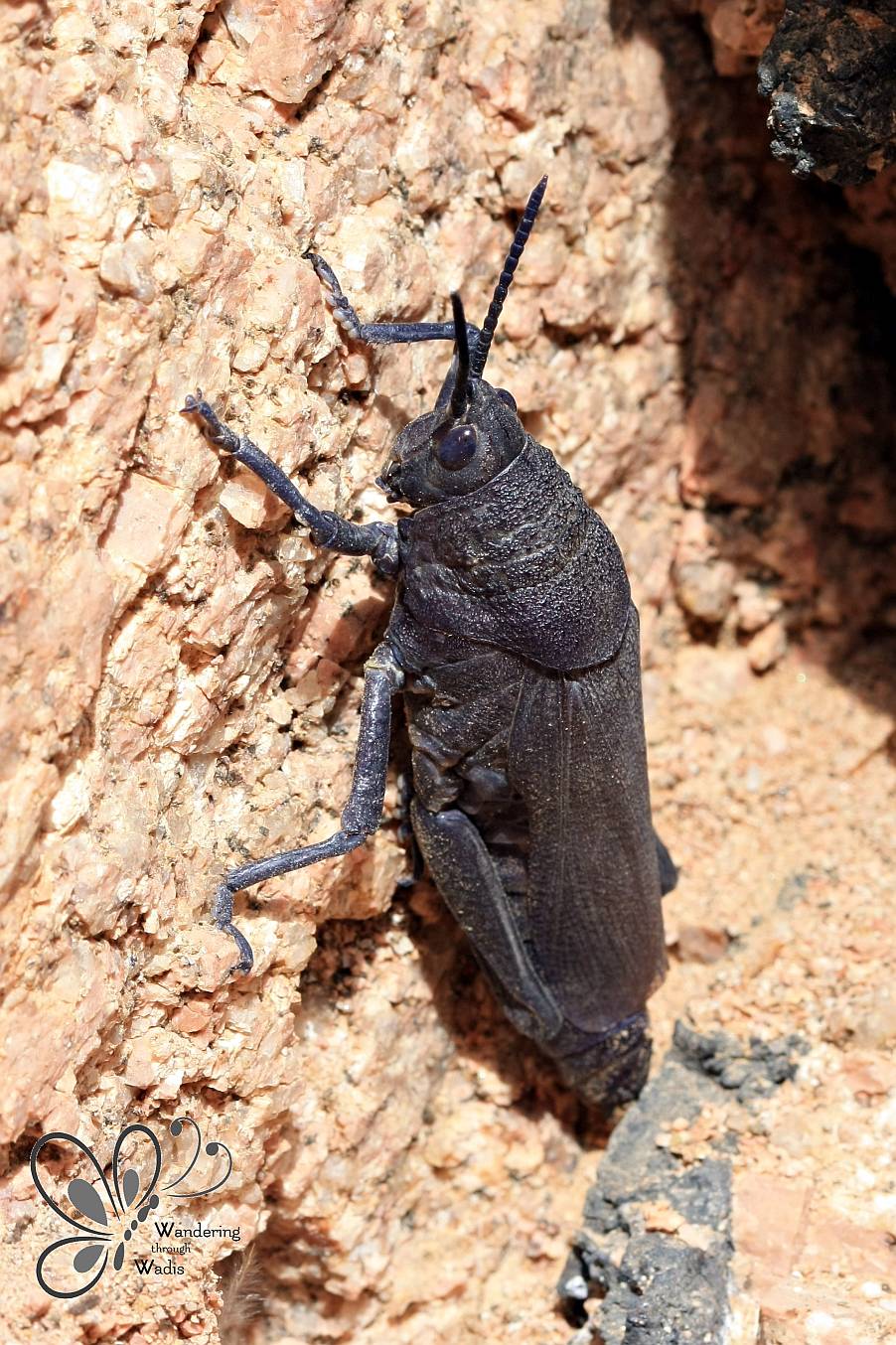
Unlike the Egyptian Flower Mantis, the Black Cone-headed Grasshopper (Poekilocerus bufonius), with its large black body and slow movement, is easy to spot!  Especially when they are resting on the rocks.

Wadi Kostya (2)

But these grasshoppers feed on plants in the milkweed family, which produce toxic chemicals. Ingesting these plants make the grasshoppers poisonous and distasteful to predators. When they are attacked, Black Cone-headed Grasshoppers spray a toxic fluid in defense. In Arabic, they are called zagat, meaning “the one who sprays toxins onto girls’ faces”.

IMG_3613

You’ll most often find these grasshoppers on Pergularia tomentosa plants. Many Bedouin, before sitting down near one of these plants, will throw stones at the bush to scare off any grasshoppers. Sometimes these plants will be home to many grasshoppers. How many can you count in the picture below?

Wadi Jiddy_Nov2010_01

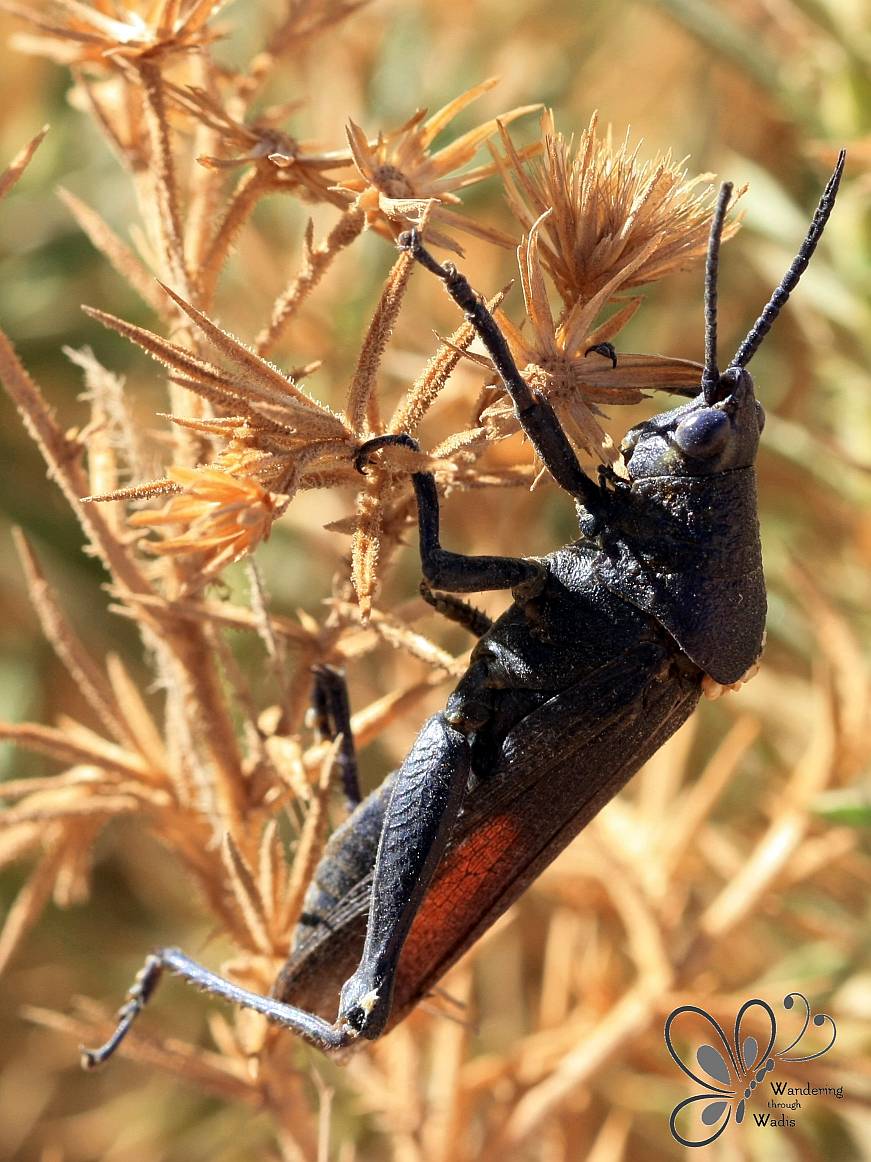
I’ve also spotted Black Cone-headed Grasshoppers on ajram (Anabasis sp.), harjal (Solenostemma arghel), reseda  (Reseda sp.), broom (Retama raetam) and other plants.

The adults that I’ve seen have been between 6 – 10 cm in length. They are black or dark-colored, sometimes with yellow spots. I’ve noticed orange underwings on several.

Wadi Kostya_Feb14 (20)

Females are substantially larger the males, as you can see in the photo of the mating pair below.

Bir Safra Area (73)

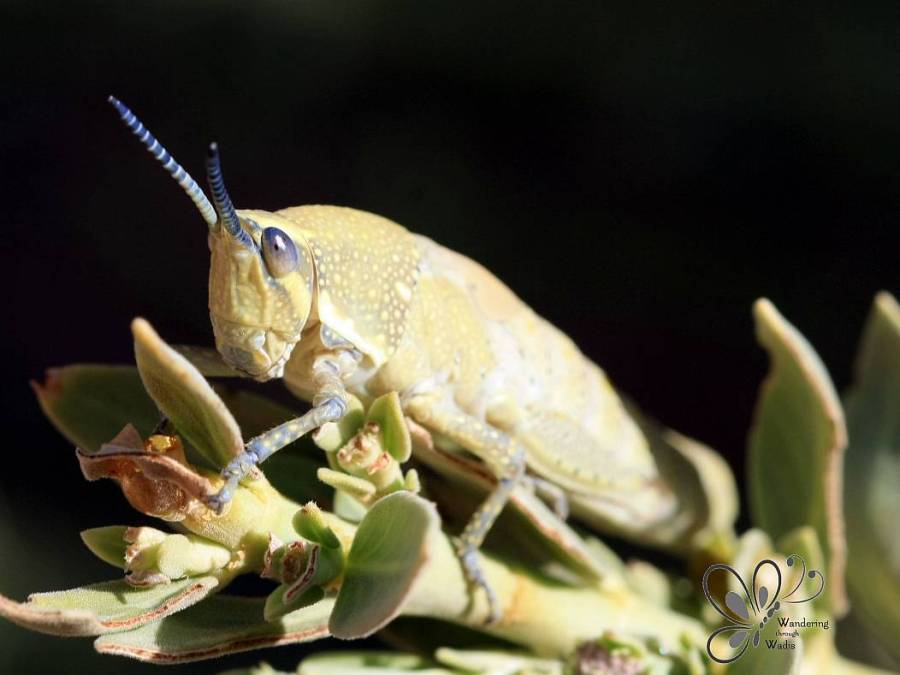
As is typical of this order of insects (Orthoptera), the grasshoppers go through incomplete metamorphosis. The young nymphs resemble the adults but have no wings and can have extremely different colors. Look at these beautiful yellow ones!

IMG_3618

As they age, they will shed their exoskeletons several times, growing wings until their final molt into a mature adult with fully-developed wings.

Wadi Connection_Feb15 (52)

I’ve spotted Black Cone-headed Grasshoppers from late fall through spring in many of the wadis around Dahab, as well as higher up near Wadi Arada (on the way to St. Katherine’s). They are one of the first critters we came across on our early wadi wanderings and I always enjoy seeing them. And photographing them! They stay so still for so long, making excellent models. 🙂

References:

Aly, D. & Khalil, R. (2011). Wildlife in South Sinai. Cairo.Funded by the E.U. in cooperation with G.O.S.S.

Zalat, S. & Gilbert, F. (2008). Gardens of a Sacred Landscape: Bedouin Heritage and Natural History in the High Mountains of Sinai. Cairo: The American University in Cairo Press.

Egyptian Red Fox

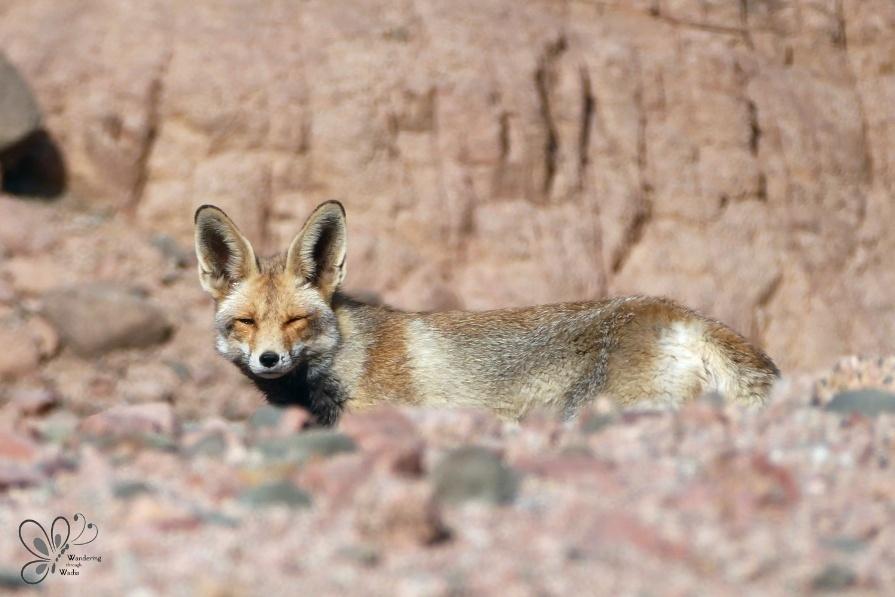
The Egyptian Red Fox (Vulpes vulpes aegyptiacus) is the largest fox in Egypt and one of three species of fox occurring in Sinai. I’ve never spotted a fox while wandering through wadis [UPDATE: I have now! See the extra pics below.], but over the years I’ve spotted several from moving vehicles. Always magical to see! But difficult to capture with a camera. (Especially if you’re the one driving.) One night, though, we were treated to a visit by a fox – a fox intent on stealing some fish!

Egyptian Red Fox (2)

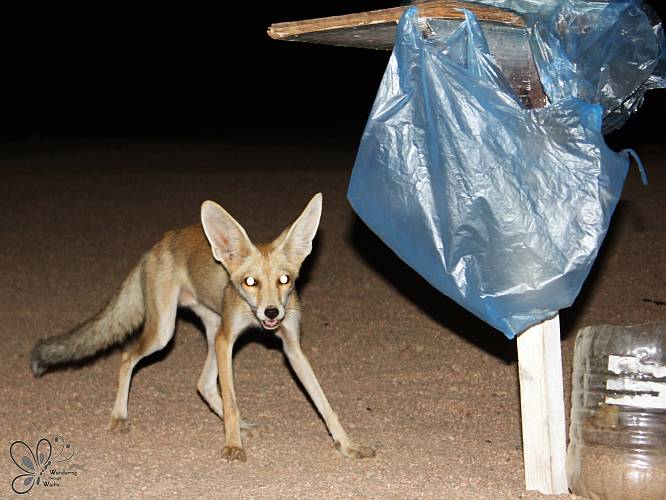
We had driven up one of the wadis behind Dahab with Eid, a Bedouin friend, who had promised to make us a traditional meal cooked over a campfire. (You can read more about the watermelon fettah here. It was delicious!) As the men were preparing the food, this fox came inching closer and closer, drawn by the scent of fish. Eid put the fish on a small raised platform to keep it away from the fox but that didn’t deter it.

Egyptian Red Fox (1)

The fox also didn’t seem bothered by the flash from my camera. He was persistent, but the fox never did get the fish and was eventually shooed away by Eid’s young son.

Egyptian Red Fox (4)

The Egyptian Red Fox lives elsewhere in Egypt and only relatively recently did they expand into South Sinai, most likely related to the increasing spread of human activity. These foxes are not foxes of true deserts. They inhabit vegetated wadis, farmland, gardens, and desert margins. We spotted this Red Fox several years ago, when tourism in Dahab was booming and this wadi was a popular destination for tourists to enjoy a desert dinner. Our Bedouin friend said this helped explain why the fox was around, feeding on leftovers, and not so scared of humans.

The foxes are nocturnal and eat insects, small rodents, fish, fruit, and vegetables. In Ras Mohamed, they are known to dig for crabs.

Although they are commonly called Red Foxes, this subspecies is not red, but more of a ruddy grey-brown. They have large ears and the hair on the back of the ears is black. Their tails are bushy and white-tipped and they have a darker-colored streak that runs from their muzzle to their eyes. Facial markings are a distinguishing feature among foxes and so can help identify the species. I am no expert, of course, and at first had thought this was a Rüppell’s Sand Fox, another species found in Sinai, but I have learned that the Sand Foxes have very distinctive black marks under their eyes. Tail color and proportion is another distinguishing feature; the Blanford’s Fox, also found here, has the longest tail of Egyptian foxes and it’s dark-tipped.

If you’re like me, though, you’ll be delighted to spot a fox in South Sinai, no matter what the species!

UPDATE: We encountered a beautiful fox in Wadi Um Ma in January 2018. We were able to watch him from a distance for several minutes before we went our separate ways.

References:

Hoath, Richard. (2003). A Field Guide to the Mammals of Egypt. Cairo: The American University in Cairo Press.

Egyptian Flower Mantis

The Egyptian Flower Mantis (Blepharopsis mendica) is also known as the Devil’s Flower Mantis, Thistle Mantis, and Arab Mantis, but of course, I like the Egyptian name. 🙂

Mantis Nymph (5)

Wadi GNai_Oct13 (29)

These mantids are referred to as Praying Mantises because of the way they hold their forelegs folded in front, as if in prayer. Mantises are also characterized by their triangular heads and forward facing eyes.

Spring is the perfect time to spot these mantises in our desert wadis. Specifically, to spot the nymphs. After hatching from their egg, mantises continue to go through several stages of growth. At each stage, the nymphs shed their exoskeletons, a process called molting. The nymphs start out small, as you can see from the photo below, and look quite different from adults.

Mantis Nymph (6)

Adults can grow up to 6 cm long and are creamy-white with a marbled green pattern. And, of course, they have wings!

Wadi Abu Ja'ada (9)

They have a small pointed shield on their backs and the inside of their forelegs are orange and blue with white spots. Females have thin antennae (above) and males have feathered antennae (below).

IMG_9298

To notice these while wandering through wadis, you’ll have to stop and take a closer look at the plants. I have spotted these mantises on a variety of desert plants – capers, acacias, and nimnam – but most often I find them on dhafrah plants (Iphiona scabra), pictured below.

Wadi Jid-dy_34

Egyptian Flower Mantises are experts at camouflage and wait patiently on the plant for prey to pass by. Their arms are well-designed to catch flying insects. In fact, what usually draws my attention is the sight of a butterfly, still and unmoving, on the bush. An odd sight as butterflies are usually flitting around quite a bit. On closer inspection, I’ll find the butterfly is not moving because it has become breakfast for either a mantis or a spider!

Wadi Farasha Mantis with Prey (5)

I’ve seen these mantises in several of the wadis around Dahab and also higher up in the area around St. Katherine’s. Where have you spotted them?

Ornate Spiny-tailed Lizard

It was tough deciding which cool creature I should feature first, but recent discussions on Project Noah had me thinking about Dhabb lizards, so they won!

Ornate Spiny-tailed Lizards (Uromastyx ornata), also called Dhabb Lizards, are one of the larger animals you’ll come across in the wadis of South Sinai, their bodies growing up to 20 cm in length. Dhabb lizards like to bask in the hot desert sun. Males choose a highly visible position to declare their territory to other Dhabbs and to be on the lookout for intruders. If you’re on the lookout while hiking, you can sometimes spot these lizards ahead of you on the rocky sides of the wadis.

IMG_3064

If you proceed slowly and quietly, the lizards will sometimes let you approach and get a closer look.

IMG_3115

But often, when they hear you coming, the lizards scramble on their short, powerful legs into a rocky crevice and all you see is their very distinctive spiny tail.

IMG_6027

Male Dhabbs, like those pictured above, have blue heads and greenish blue backs with bands of black-edged yellow spots. The female and juvenile lizards sport a similar pattern but in reds, browns, and greys. Their coloration overall, however, can vary quite a bit depending on age, sex, and breeding condition.

IMG_3230

Ornate Dhabb lizards are active during the day and they are most active at midday during the hottest months of the year. They are herbivorous, munching mainly on the leaves, seeds, and flowers of desert plants. Occasionally, they might feed on invertebrates like insects and spiders.

A few years ago, while hiking one of our regular routes, my husband and I came across a Dhabb lizard feeding on the lush desert plants underneath an acacia tree. (There had been a bit of winter rain so the wadis were quite green with vegetation. And Dhabbs are strongly associated with acacias.) The Dhabb did not seem bothered by our presence and carried on eating as I sat on a nearby rock with my camera . What a treat it was to be able to watch!

Geocache Dabb (53)

Ornate Spiny-tailed Lizards are listed as a species of Least Concern on the IUCN Red List of Threatened Species. However, the Red List justifies this classification, recognizing that the lizard has gone locally extinct in parts of Egypt and Israel but continues to thrive as a species in Saudi Arabia. The lizards are heavily collected by animal traders despite the fact that exporting this species is illegal in Egypt. In Sinai, Dhabb lizards are also threatened by loss of habitat due to tourist activities, removal of acacia trees for charcoal making, quarrying, and general development.

So, please remember, when visiting Sinai’s spectacular deserts:

Take nothing but pictures,
Leave nothing but footprints,
Kill nothing but time.

Geocache Dabb (46)

References:

Wilms, T. & Sindaco, R. 2012. Uromastyx ornata. The IUCN Red List of Threatened Species 2012:e.T198538A2531743.http://dx.doi.org/10.2305/IUCN.UK.2012.RLTS.T198538A2531743.en. Downloaded on 08 May 2016.

Baha El-Din, Sherif. (2006).  A Guide to the Reptiles and Amphibians of Egypt. Cairo: The American University in Cairo Press.

Ornate spiny-tailed lizard (Uromastyx ornata)  on Arkive.org